

Why Traditional Listing Creation Is Leaking Profit
Manual listing creation does not scale because the work extends far beyond writing a title and a few bullets. Sellers must research competitors, identify customer pain points, score existing content, plan claims, produce images, coordinate revisions, and upload assets to Seller Central. When each SKU follows a disconnected process, listing cycle time expands and valuable operator capacity is consumed by repetitive tasks rather than decisions that can improve CTR, CVR, ACoS, or BSR.
The deeper problem is that manual workflows often treat each content element as a separate task. A title is rewritten, images are replaced, and bullets are edited, but the team may not establish how those changes work together to move a shopper from recognition to understanding, trust, and purchase.
A gel air freshener Listing illustrates this risk. The page contained the basic elements of an Amazon product page—an image, title, bullet points, descriptive content, and reviews—but those elements did not form a connected buying path. The title did not clearly establish the product category, the main image did not answer practical questions about size or placement, the bullet points made broad promises without showing how the product delivered them, and the detail section repeated information rather than developing a visual explanation. The page was not empty; it was incomplete at several decision points.
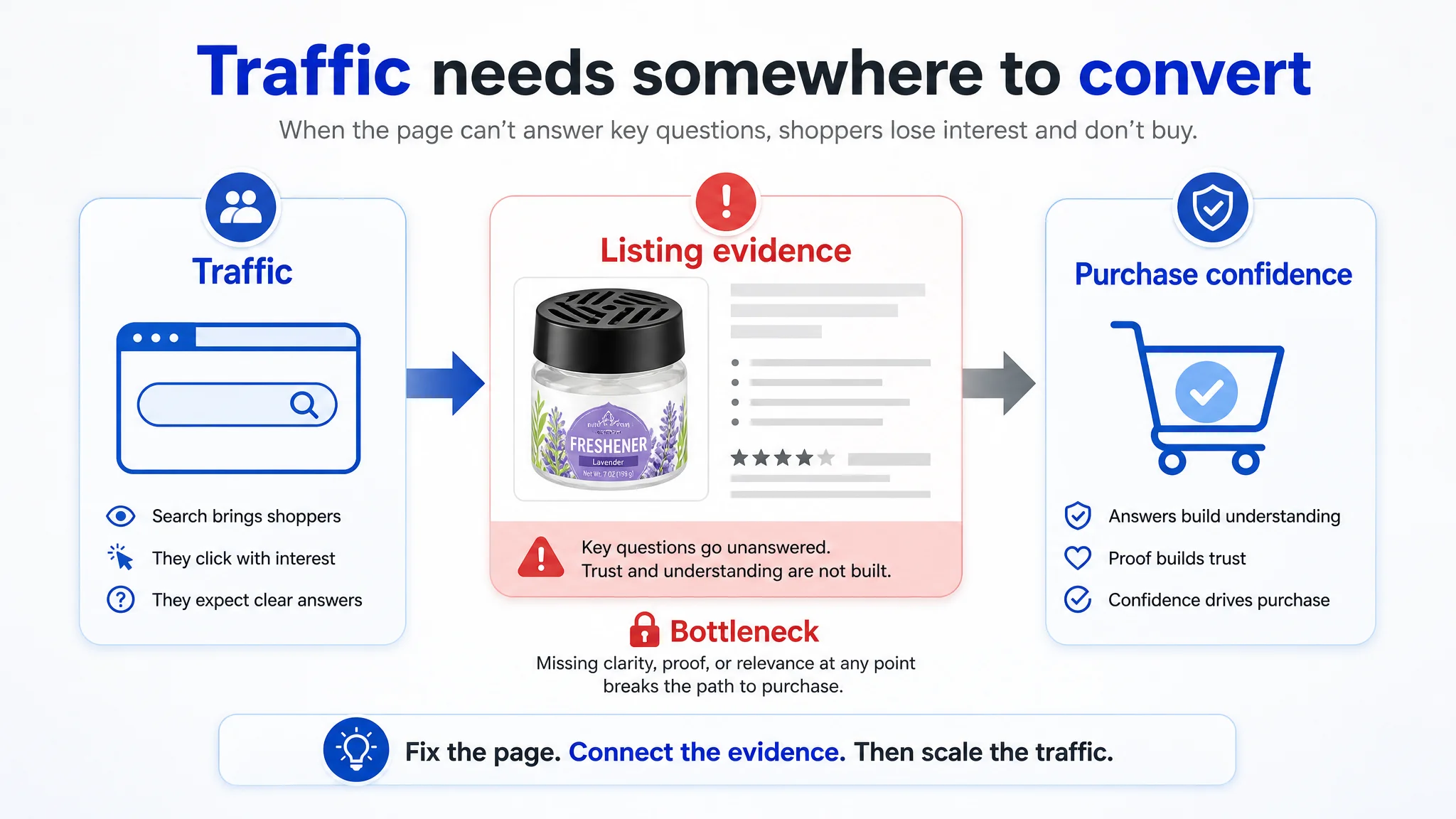
That distinction matters for AI adoption. Generating more copy does not automatically repair a Listing whose content lacks commercial sequencing. The system must help sellers identify which part of the buyer’s decision process is breaking and then assign each asset a specific role.
The financial pressure rises as competition makes every click more expensive. A listing with weak positioning or unclear visual communication may require more paid traffic to generate the same number of orders. As CPC increases, a low-CVR detail page can turn additional advertising spend into tens of thousands in avoidable cost. That does not automatically mean a seller is losing six figures; losses at that level typically require advertising spend above $50,000 per month. The practical point is conditional: where content contributes to weak conversion, the leak can become material surprisingly quickly.
The gel air freshener diagnosis showed why traffic and content cannot be evaluated independently. The Listing scored 33 out of 100 against 75 for a comparable high-performing listing. The largest gap was in the detail-page dimension, which was 19 points behind, followed by the main image and reviews. This did not prove a particular advertising loss or post-optimization gain, but it did show that additional traffic would be entering a page with major gaps in product understanding and trust.
AI listing tools should therefore be evaluated as operational and financial infrastructure, not as a convenience. If a system can connect diagnosis, planning, content production, and delivery, it may reduce repeated labour and shorten the path from identifying a listing issue to implementing a correction. A product-specific workflow that reduces an upload operation from roughly 30 minutes to seconds can also release time for competitor analysis and performance review.
The decision is not whether AI can produce attractive copy. It is whether verified, measurable content workflows can reduce listing cycle time and support stronger CTR and CVR without introducing factual risk.
Amazon's Free AI Listing Tools - What They Get Right and Where They Stop
Amazon’s native AI tools are a practical first step for sellers who need faster listing production without adding software cost. Their value is strongest when the problem is content creation; it becomes narrower when the problem is performance diagnosis.
AI Listing Generator (Q2 2025)
Released in Q2 2025, the AI Listing Generator can turn existing product information into draft titles, bullets, and descriptions. It reduces listing cycle time and gives sellers a usable baseline, especially when launching multiple ASINs. Amazon has cited a 40% quality improvement, but this is an Amazon internal metric, not an independently verified result that applies universally.
A generated draft can help a seller establish a starting point, but a baseline is not the same as a conversion diagnosis. In the gel air freshener Listing, the customer’s initial direction already contained relevant themes such as lasting freshness, multi-room use, and brand history. The problem was not simply that the page lacked more claims. Those claims were presented as isolated statements and did not explain how the product worked, where it could be used, or why the shopper should trust the specific format.
This is where content generation reaches its practical limit. AI can make existing information more readable, but it may not determine that the larger issue is a missing sequence from product recognition to purchase confidence.
Enhance My Listing & Dynamic Canvas
Enhance My Listing helps refine existing content, while Dynamic Canvas supports richer, more adaptive product-page presentation. Together, they can improve content completeness and reduce repetitive manual editing. They do not, by themselves, establish whether a change improved CTR, CVR, ACoS, or BSR, nor do they provide a structured comparison against the most relevant competing ASINs.
The distinction between completeness and effectiveness is important. The gel air freshener page had the expected content components, but the content did not perform as a connected system. Its bullet points moved between longevity, room use, and brand history without creating a clear action-to-result sequence. By comparison, the stronger listing connected adjustment of the product with fragrance release, odor control, and the resulting clean scent experience.
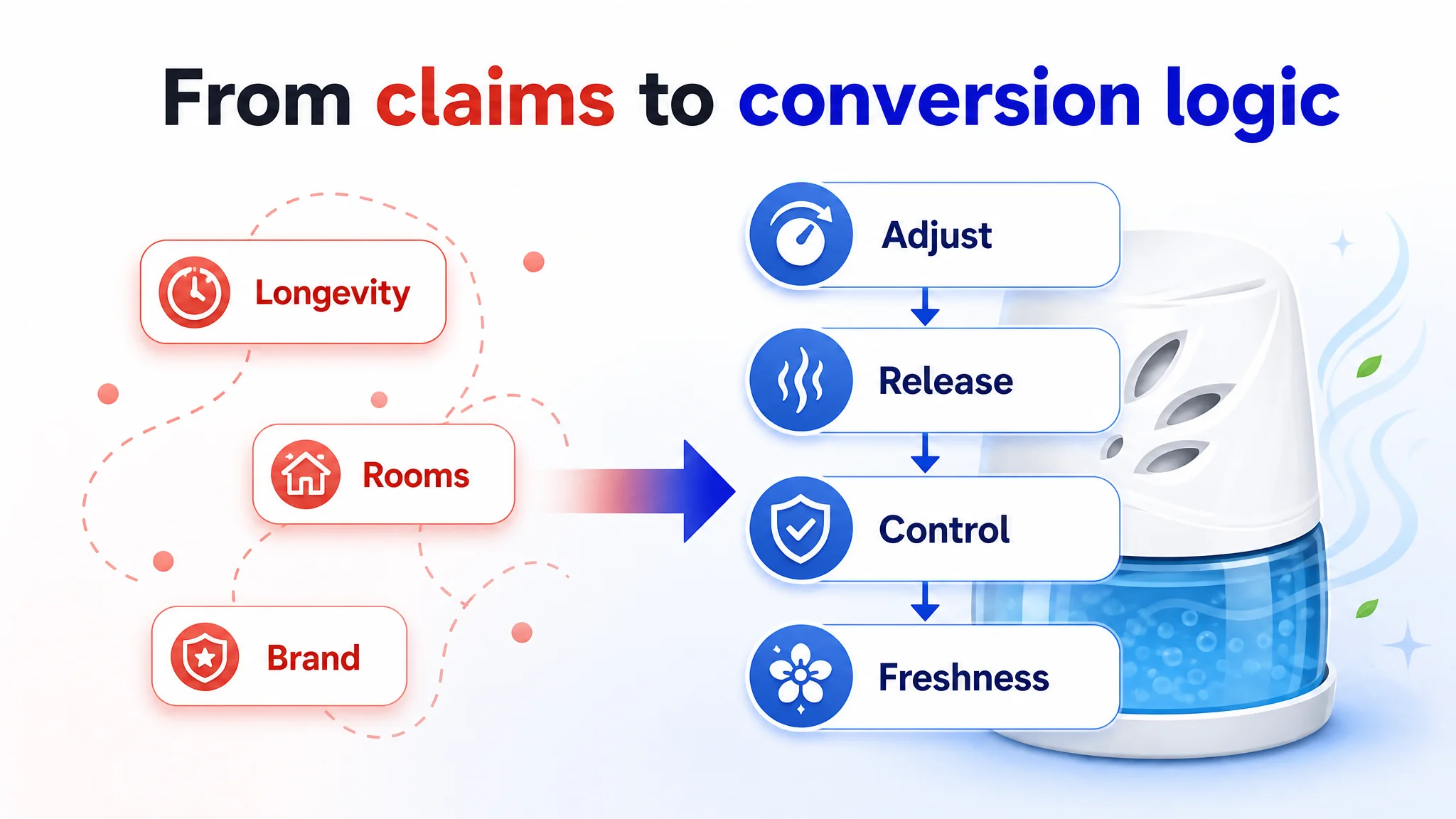
A richer canvas would be useful only if each module had a defined job. One image might identify the product, another might establish size and placement, and another might demonstrate how the adjustable cone controls fragrance intensity. Without that planning layer, richer presentation can simply produce more content without resolving the buyer’s questions.
Seller Assistant Forecasting
Seller Assistant adds planning support through forecasting-oriented guidance. That can help sellers think beyond individual copy edits and connect decisions with expected business direction. Its practical limit is that forecasting is not the same as a full listing audit: it does not replace systematic analysis of which image, title element, bullet, or A+ module is creating the performance gap.
A forecast may suggest that a product deserves more attention, but it does not explain why shoppers are failing to move forward after arriving on the page. In the gel air freshener diagnosis, the decisive finding came from locating the score gap: the Listing was 19 points behind in the detail-page dimension, while the title, main image, and reviews also lagged the comparable listing. That information changed the priority order from strengthening individual claims to rebuilding the page’s conversion logic.
When the Free Ceiling Demands an Upgrade
The free tools have done their job when the seller has a competent draft but still cannot explain why CTR or CVR is weak, which competitor sets the relevant benchmark, or which change deserves priority. Platforms such as DeepBI extend the workflow with intelligent scoring across listing components, similarity-constrained competitor benchmarking, and AI-generated visual-text packages. They can connect recommendations with metrics such as CTR, CVR, ACoS, and listing cycle time, then support structured generation and application rather than isolated edits.
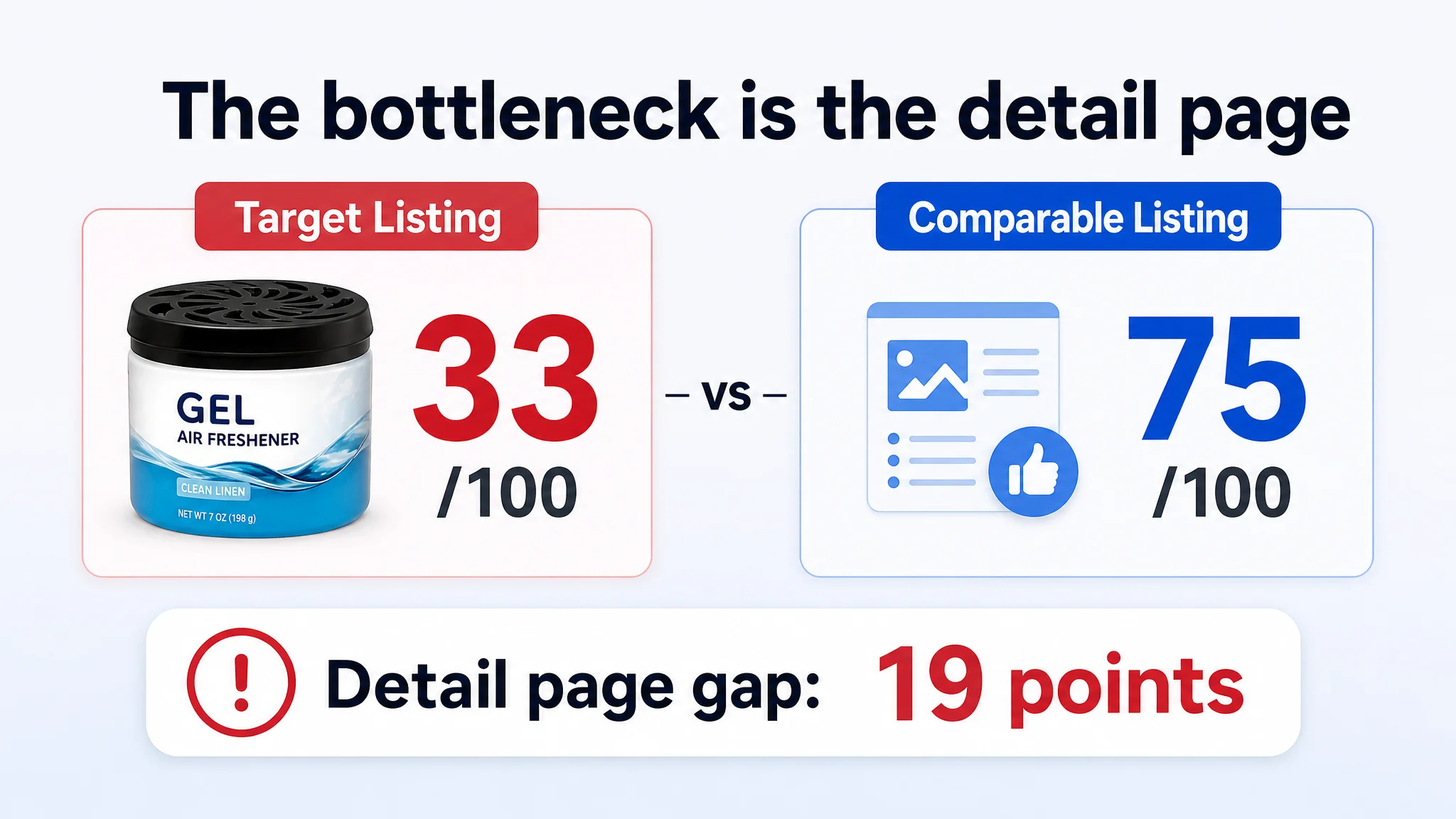
The gel air freshener example shows why this additional layer matters. The customer’s working direction leaned toward reinforcing freshness claims, multi-room use, and brand history. DeepBI’s diagnosis identified a more fundamental constraint: the page did not provide enough connected evidence for a shopper to understand the product, evaluate its use, and feel confident purchasing it. The score of 33 compared with 75 for the comparable Listing made the issue more concrete, while the breakdown showed where the page was losing decision support.
An upgrade is therefore easier to justify when it does more than produce language. It should help answer three operational questions:
1. Which part of the Listing is creating the performance gap?
2. What should each replacement asset accomplish?
3. How will the seller know whether the change improved the relevant KPI?
The ROI-Driven Framework: What You Should Really Pay for AI-Powered Amazon Tools
Listing Optimization ($0-99/month) - The Break-Even That Makes It Obvious
- DeepBI Listing Product Documentation: Start with free tools for occasional edits. A paid listing optimizer at $0–99 per month becomes easier to justify when you launch at least five new products monthly or update more than 50 existing listings. Its value should be measured through listing cycle time, CTR, CVR, and ACoS—not a blanket promise of higher sales. DeepBI connects listing diagnosis, revised assets, and advertising data so sellers can observe CTR changes during the 7–14 days after an image update.
The value becomes clearer when a Listing requires coordinated changes rather than a single copy edit. In the gel air freshener example, the recommended direction involved clarifying the product type in the title, establishing size and placement through the image sequence, restructuring bullets around action and result, and replacing repetitive content with focused A+ modules. A workflow that handles these decisions as one connected process can be more useful than several isolated drafting tools.
The case also supports a cautious approach to ROI. The diagnosis established a score gap and specific content weaknesses, but it did not provide post-optimization advertising results. Therefore, the business case should rest on reduced listing cycle time, clearer prioritization, and measurable movement in CTR or CVR—not on an assumed sales lift.
Repricing ($99-500/month) - Protecting the Buy Box So Your Listing Works
- Amazon growth framework: Repricing at $99–500 per month supports the commercial conditions that allow listing content to convert. Buy-box ownership protects the opportunity created by a strong title, image, or A+ page. Calculate break-even from the gross profit preserved by maintaining competitive offer placement, rather than assuming every seller will achieve the same sales lift.
Repricing can protect the commercial opportunity, but it cannot solve a page that does not explain the product. A shopper may see a competitively priced offer and still hesitate if the Listing does not clarify whether the item is a gel, spray, plug-in, or another format, or if the page does not demonstrate how it is used.
The gel air freshener Listing made this separation visible. The proposed title needed to make the category, scent, and size immediately understandable, while the images and A+ content needed to explain placement and operation. Protecting the Buy Box would support the Listing, but it would not replace the product explanation required for conversion.
PPC Automation ($250-695/month) - Traffic That Only Pays with a Conversion-Ready Listing
- Advertising optimization materials: PPC automation priced at $250–695 per month is more economically defensible when monthly ad spend reaches approximately $3,000 or more. Before paying for automation, confirm that the listing can convert the traffic: weak CTR points to an image or relevance problem, while weak CVR may indicate gaps in content, trust, or reviews. Automation cannot compensate for an unprepared listing.
Many teams initially interpret weak commercial performance as an advertising problem and respond by changing bids, keywords, or campaign structure. That can be a reasonable response when the Listing is already capable of explaining the offer. It is less useful when the page has not answered the shopper’s basic questions.
In the gel air freshener case, the customer’s initial direction focused on strengthening product claims. The diagnosis instead showed that the page lacked a connected path from recognition to purchase confidence. More impressions would not resolve the missing core phrase “Gel Air Freshener” in the title. More clicks would not demonstrate how the adjustable gel cone worked. More sessions would not compensate for an A+ section that repeated information instead of building trust.
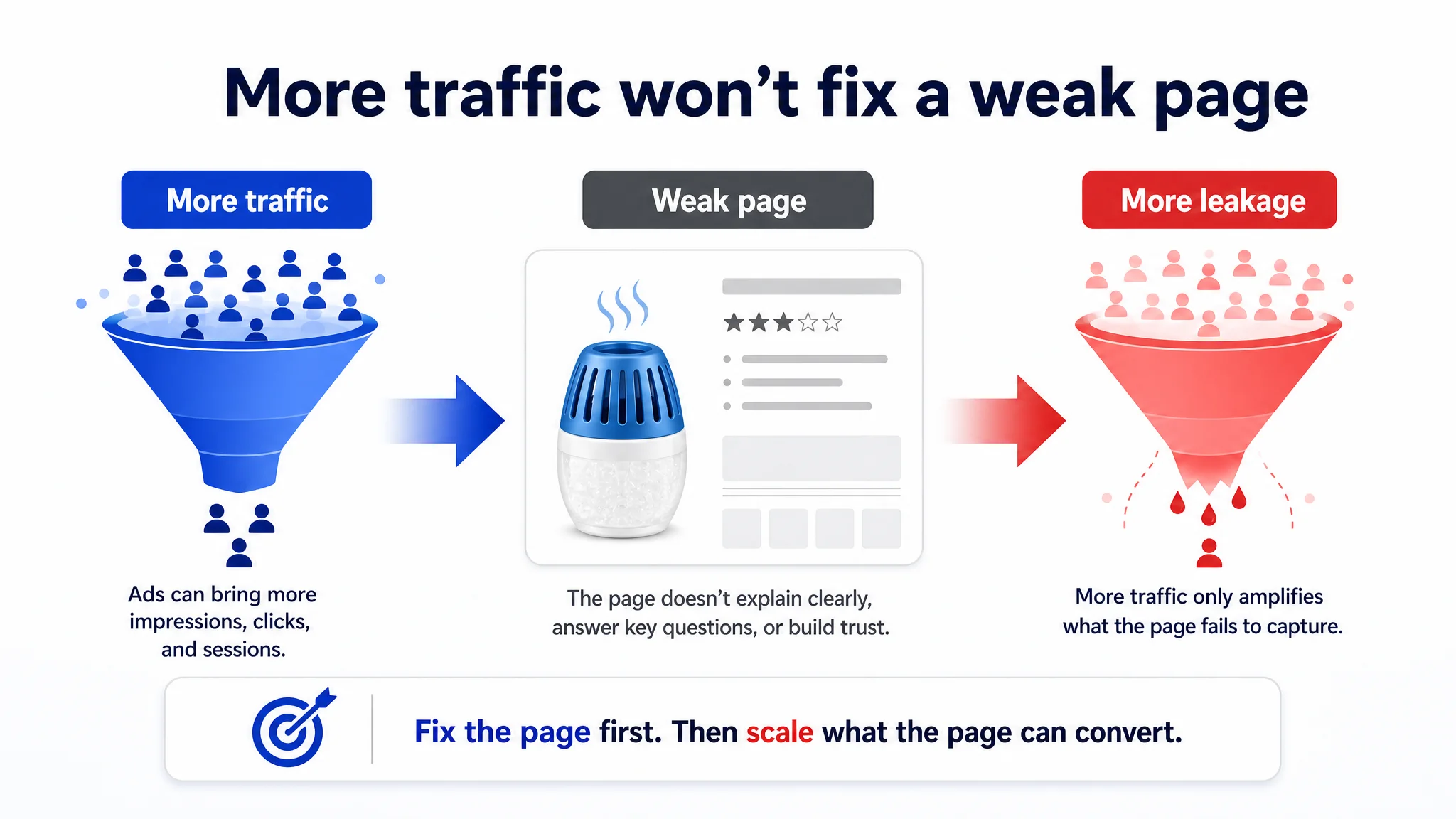
This does not mean advertising should automatically stop. It means traffic should not be treated as the first and only lever. Before scaling PPC automation, sellers should establish whether the Listing can receive traffic fairly by making the product searchable, understandable, visually demonstrable, and credible.
Inventory Forecasting ($49-250/month) & Review Analysis ($34-140/month) - The Listing-Improvement Feeders
- Adjacent-tool logic: Inventory forecasting at $49–250 per month protects listing performance by reducing stock-out risk and preserving conversion opportunities. Review analysis at $34–140 per month should be treated as an input for listing creators, not a complete review-management system. Review patterns can reveal customer pain points that inform bullets, images, and A+ content.
Reviews are particularly important as part of the trust layer, but they cannot compensate for missing product logic. In the gel air freshener comparison, the target Listing had a 3.9-star rating and 26 total reviews, compared with 4.3 stars and 207 reviews for the comparable listing. That weaker trust base increased the importance of making the title, images, bullets, and A+ content clear and credible.
Review analysis should therefore help the team understand which concerns need to be answered through content. It should not lead the team to assume that adding more review-oriented messaging will fix a page whose format, operation, or use case remains unclear. Review signals, inventory continuity, and Listing content address different parts of the commercial system.
The Core Question - Does AI-Generated Content Really Lift Listing Performance?
The Metrics That Matter: CTR, CVR, and Amazon's Quality Score
AI-generated copy, images, and A+ Content are effective only when they improve measurable funnel outcomes. Track CTR to evaluate whether the title, main image, and visual hierarchy earn more clicks; track CVR to determine whether the detail page converts that traffic. Review Amazon listing-quality indicators alongside these metrics, while separating them from any third-party diagnostic score. ACoS, orders, and BSR provide useful commercial context, but they should not replace CTR and CVR analysis.
The distinction between a diagnostic score and a business KPI is important. The gel air freshener Listing scored 33 out of 100 against 75 for a comparable listing, and the breakdown identified a 19-point detail-page gap. That score helped locate the structural weakness, but it did not prove that a particular change would produce a defined CVR increase or ACoS decline.
A practical measurement sequence would therefore use the score to establish priorities, then use CTR and CVR to evaluate commercial movement. If a revised main image earns more clicks but CVR remains weak, the next question may concern page explanation, trust, or offer clarity. If CTR remains weak, the issue may still be search relevance or thumbnail communication. The metric should guide the next diagnosis rather than serve as a substitute for one.
How AI-Driven Listing Diagnostics Go Beyond Simple Drafting
A draft is not evidence of impact. Establish a baseline, record the application timestamp, then compare post-publication CTR, CVR, and diagnostic scores against the prior period while accounting for major traffic or advertising changes. Sellers can manually audit old and proposed assets side by side, select individual replacements, and review the resulting trend; this is comparison-based monitoring, not DeepBI A/B testing.
DeepBI supports this loop through intelligent scoring, competitor benchmarking, and checks for visual appeal, information density, compliance, and product-DNA consistency. Approved copy and graphics can be synchronized through SP-API, with visual iteration events supporting continued tracking over the following 7–14 days.
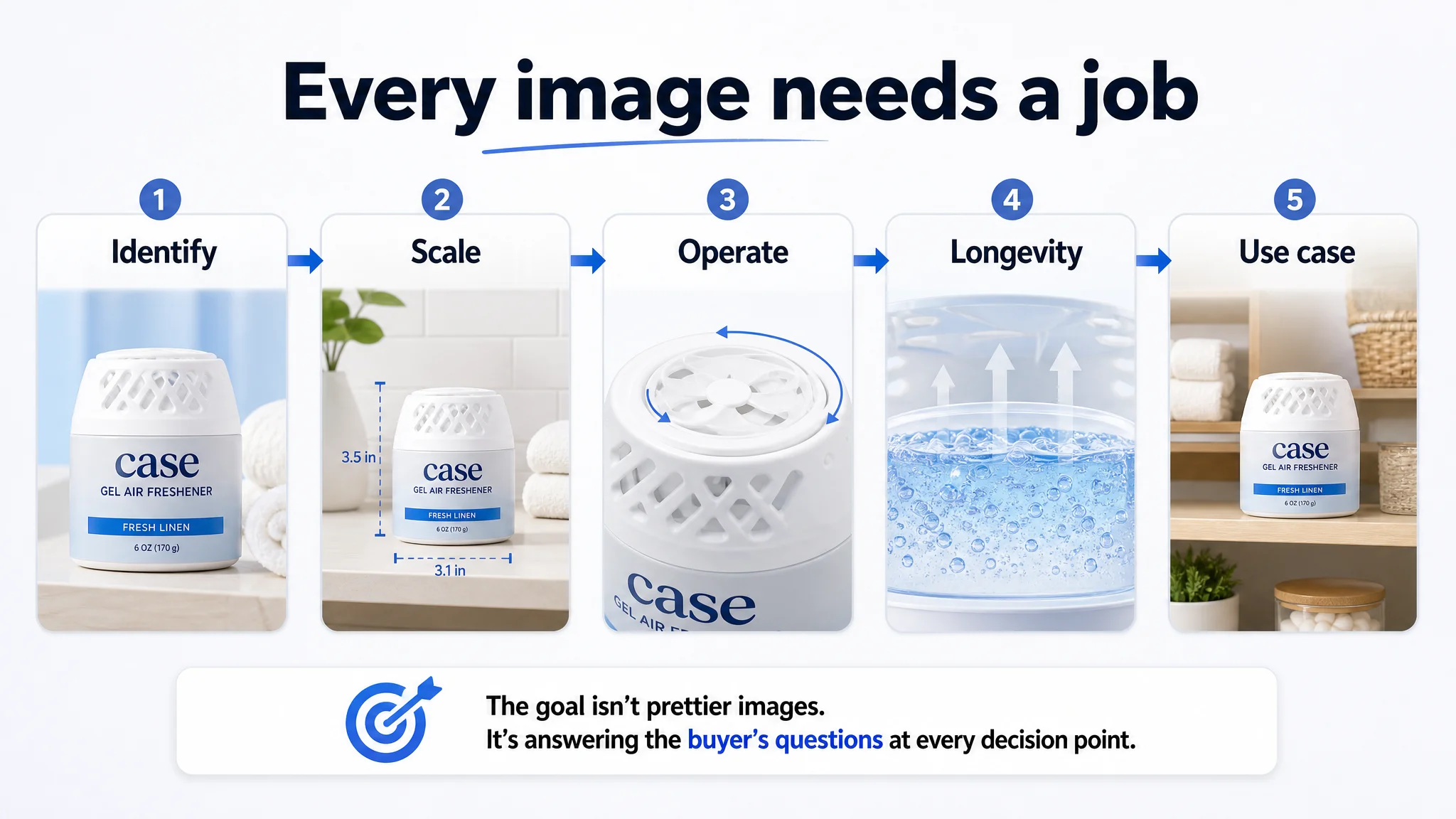
The value of diagnosis is that it prevents sellers from measuring the wrong intervention. In the gel air freshener Listing, the title, image, bullets, detail page, and reviews all showed gaps, but those gaps were not equally important. The detail page was 19 points behind the comparable Listing, while the main image was 9 points behind. That evidence suggested that the work could not be reduced to a title rewrite or a cosmetic image refresh.
The proposed image sequence also demonstrates how diagnostics should inform production. Each image was assigned a distinct role:
1. Identify the gel air freshener format, scent, and size.
2. Establish physical scale and placement.
3. Demonstrate how the adjustable mechanism works.
4. Explain the gel format and continuous-release concept.
5. Confirm a relevant home use case.
This is more measurable than asking whether the new images simply look better. Each asset is designed to address an information gap that may influence CTR, CVR, or both.
A+ Content Gains and the Danger of Fabricated Claims
Amazon has cited potential sales lifts of up to 8% for basic A+ Content and up to 20% for premium A+ Content when appropriately used. These are qualified possibilities, not guarantees. Any A+ expansion must strengthen product understanding without inventing specifications, benefits, or use cases.
The gel air freshener Listing shows why A+ Content should be treated as a conversion system rather than a larger text area. The existing detail-page content repeated information instead of building a visual progression. The recommended A+ structure focused first on the specific After the Rain gel cone, then on relevant household placement, the adjustable mechanism, and the product’s intended freshness and odor-control experience.
The comparison also provided an important warning. A competitor’s A+ content included broader category messaging and other scents or formats, but copying those modules could distract shoppers from the specific ASIN under consideration. Effective A+ content should deepen confidence in the product being viewed, not introduce unnecessary alternatives.
The purpose of A+ is therefore not to make a page appear more complete. It is to answer questions that the title, main image, and bullets cannot answer efficiently, while keeping every claim aligned with the available product evidence.
Why Human Fact-Checking Remains the Final ROI Multiplier
AI can overclaim, misstate product facts, blur differentiation, or pair keywords with unsupported attributes. Product DNA constraints reduce image-product mismatch risk, but human review remains essential for accuracy, compliance, and brand credibility before publication. DeepBI should guide intelligence-driven iteration; the seller remains accountable for the final asset and claim.
The product-specific nature of the gel air freshener recommendations illustrates why this review cannot be skipped. “Adjustables” had limited value as a phrase unless the page accurately showed what could be adjusted and how the mechanism operated. The stated duration of up to three weeks also needed to remain within the supportable product story. Similarly, the family-owned-since-1908 message could reinforce trust, but it should not replace evidence about the specific product.
Human review should confirm that the AI-generated title, images, bullets, and A+ modules preserve the actual product format, size, mechanism, scent, use cases, and supported claims. Persuasive content that introduces ambiguity or unsupported detail can create a new conversion and compliance risk rather than improving ROI.
A Seller's Gradual Path: From Zero Cost to Scalable AI Adoption
Composite seller journey: a staged adoption model
Consider a fictional seller managing a growing portfolio of Amazon products. The seller begins with Amazon’s free AI listing tools, using them to draft or refine titles, bullets, and descriptions rather than committing budget immediately. Every published change is reviewed for accuracy and compliance, then tracked against two baseline metrics: CTR, which indicates whether the listing earns attention, and CVR, which shows whether that traffic converts.
At this stage, the objective is not to promise a fixed lift. It is to establish a measurement habit and identify whether listing changes produce a meaningful directional improvement for the specific product, traffic mix, and category.
The gel air freshener diagnosis shows why the baseline should include more than a copy draft. Before making changes, the team could document how clearly the product category appears in the title, what questions the main image answers, whether the bullets connect action with result, and whether the A+ content develops a product-specific explanation. A diagnostic score and competitor comparison can provide additional structure, but the commercial baseline still needs to include CTR and CVR.
Once the seller reaches five or more product launches per month, manual research, drafting, comparison, and publishing begin to consume material time. A paid listing optimization tool becomes easier to justify because it can support a repeatable workflow: diagnose performance, recommend changes, compare old and new assets, and feed subsequent CTR and CVR data into the next iteration. The business case rests on reduced listing cycle time and clearer KPI movement, not on AI adoption alone.
This repeatable workflow is particularly valuable when the Listing requires coordinated repairs. In the gel air freshener example, the work involved more than generating a new title. The page needed search clarity, visual explanation, functional communication, focused A+ content, and supporting trust signals. A system that can connect those tasks may reduce the risk of improving one component while leaving the underlying conversion bottleneck untouched.
Only after monthly advertising spend exceeds $3,000 does the seller add PPC automation. At that scale, ACoS and campaign-management workload can warrant another layer of tooling, provided the underlying listing data is reliable.
Before reaching that stage, the seller should ask whether the page is ready to receive more traffic. If the title does not make the product type clear, the main image does not establish use or scale, and the detail page does not explain the product mechanism, campaign automation may make the resulting inefficiency easier to observe without solving its cause.
This gradual path protects cash flow: start free, measure first, and upgrade when launch volume, ad spend, workload, and KPI evidence justify the expense. Results will vary, so each step should be validated against the seller’s own CTR, CVR, ACoS, and operational capacity.
Conclusion - The AI-Assisted Listing Is Not the Future; It's Today's Profit Edge
- Platform Guidelines: Start with Amazon’s free listing tools where they cover the immediate need, then upgrade only when measurable workload, listing cycle time, CTR, CVR, ACoS, or account-management demands justify additional investment. Automated checks still need to protect image dimensions, background requirements, and title limits.
- Brand Compliance: AI-generated content should accelerate production, not replace judgment. Human review remains necessary to verify product accuracy, claims compliance, established brand voice, and strategic positioning before anything is published.
- Product DNA and Product Entity Consistency: The product itself must remain the highest-priority constraint. AI must not invent features, alter product structure, or introduce unsupported claims merely to produce more persuasive copy or imagery.
- Application and Delivery: A practical hybrid model combines AI diagnosis, content generation, evaluation, and workflow support with human comparison, selection, fact-checking, and approval. “One-click” application should never mean unexamined application.
- DeepBI Listing Product Documentation: DeepBI is a logical next step for boutique sellers, multi-SKU operators, and teams whose repetitive analysis and production needs exceed Amazon’s free-tool plateau. Its value should be judged through measurable signals such as impressions, clicks, CTR, CVR, orders, ACoS, and TACoS—not assumptions of universal profit improvement. The gel air freshener diagnosis demonstrates why this value is not limited to copy generation: scoring and competitor comparison helped identify that the main constraint was the page’s ability to explain and support the product, especially within the detail page and A+ content.
- AI-Assisted Listing Workflow: Treat every published iteration as the start of measurement. Use free tools first, establish performance and workload thresholds, and scale into advanced platforms only when the data shows that deeper diagnosis, batch production, and controlled application can support the business case.
The broader operating lesson is straightforward: before asking whether AI-generated content can increase performance, determine whether the Listing has enough connected evidence to earn attention, explain the product, answer practical questions, and build confidence.
In the gel air freshener example, the page did not simply need more claims. It needed a clearer decision path: identify the product as a gel air freshener, show its size and placement, explain the adjustable mechanism, connect use with the intended outcome, and use A+ content and trust signals to support the specific ASIN.
That is the standard AI-assisted listing workflows should meet. AI should reduce production friction, but diagnosis should determine what gets produced, measurement should determine whether it worked, and human review should determine whether it is safe and accurate to publish.