

Introduction
Launching a product with strong market demand is only the first step in building a profitable Amazon business. Without rigorous listing optimization, even the most innovative products will struggle to capture market share. Optimization is the critical mechanism that bridges the final gap—transforming static digital assets into immediate commercial value. It is the core engine that drives search visibility, accelerates sales velocity, and ultimately secures a dominant Best Sellers Rank (BSR). Despite its undeniable impact, many Amazon sellers encounter significant operational roadblocks. When performance metrics stall—such as when Click-Through Rates (CTR) drop below 0.35% or Conversion Rates (CVR) fall under 7%—sellers frequently resort to blind modifications based purely on subjective aesthetics. This is particularly common when attempting to optimize the listing main image or rewrite backend search terms. Relying on guesswork rather than data not only inflates the Advertising Cost of Sales (ACoS) but also creates severe bottlenecks for large-scale sellers managing hundreds of SKUs. Without a systematic approach, executing visual iterations across a massive catalog becomes a labor-intensive task that drastically slows down the overall listing cycle time.The objective of this guide is to provide a definitive, actionable framework to resolve these challenges in 2025. By leveraging intelligent listing scoring and dynamic competitor benchmarking as a front-end diagnostic radar, sellers can accurately pinpoint critical performance gaps. Through these advanced strategies, you will learn how to translate complex operational decisions into a standardized engineering path, transitioning from manual trial-and-error to industrialized execution that maximizes CTR, CVR, and long-term profitability.
Table of Contents
- Introduction: The 2025 Landscape of Amazon Listing Optimization A comprehensive overview of how evolving visual workflows impact core metrics, ranging from ACoS efficiency to overall BSR rankings.
- Diagnosing Your Listing: Market Data and Benchmarking - Identifying Funnel Leaks: Pinpointing critical performance thresholds, specifically when traffic funnel CTR falls below 0.35% or trust funnel CVR drops under 7%. - Semantic Benchmarking: Leveraging distributed capture matrices and multidimensional algorithms to analyze global market data and generate precise competitiveness radar charts.
- Strategic Planning: Turning Data into Actionable Instructions Translating unstructured market scoring data into highly executable directives to systematically accelerate the listing cycle time.
- Visual Asset Generation: The Production Engine - Global Localization: Utilizing built-in environment camouflage tailored for over 20 international Amazon marketplaces. - Advanced Image Directives: Executing specific visual adjustments, such as centering products at 60% scale, utilizing 45-degree side viewing angles, and applying warm-toned town backgrounds.
- Automated Execution: Instant Asset Delivery Overcoming traditional delivery bottlenecks by entirely bypassing manual operations—such as downloading, renaming, and individual backend uploading—to ensure optimization outcomes take effect immediately.
- Conclusion: The Operational Decision System Transitioning from a basic content production tool into a comprehensive operational execution system that continuously secures CTR and CVR growth.
Amazon Listing Optimization with DeepBI
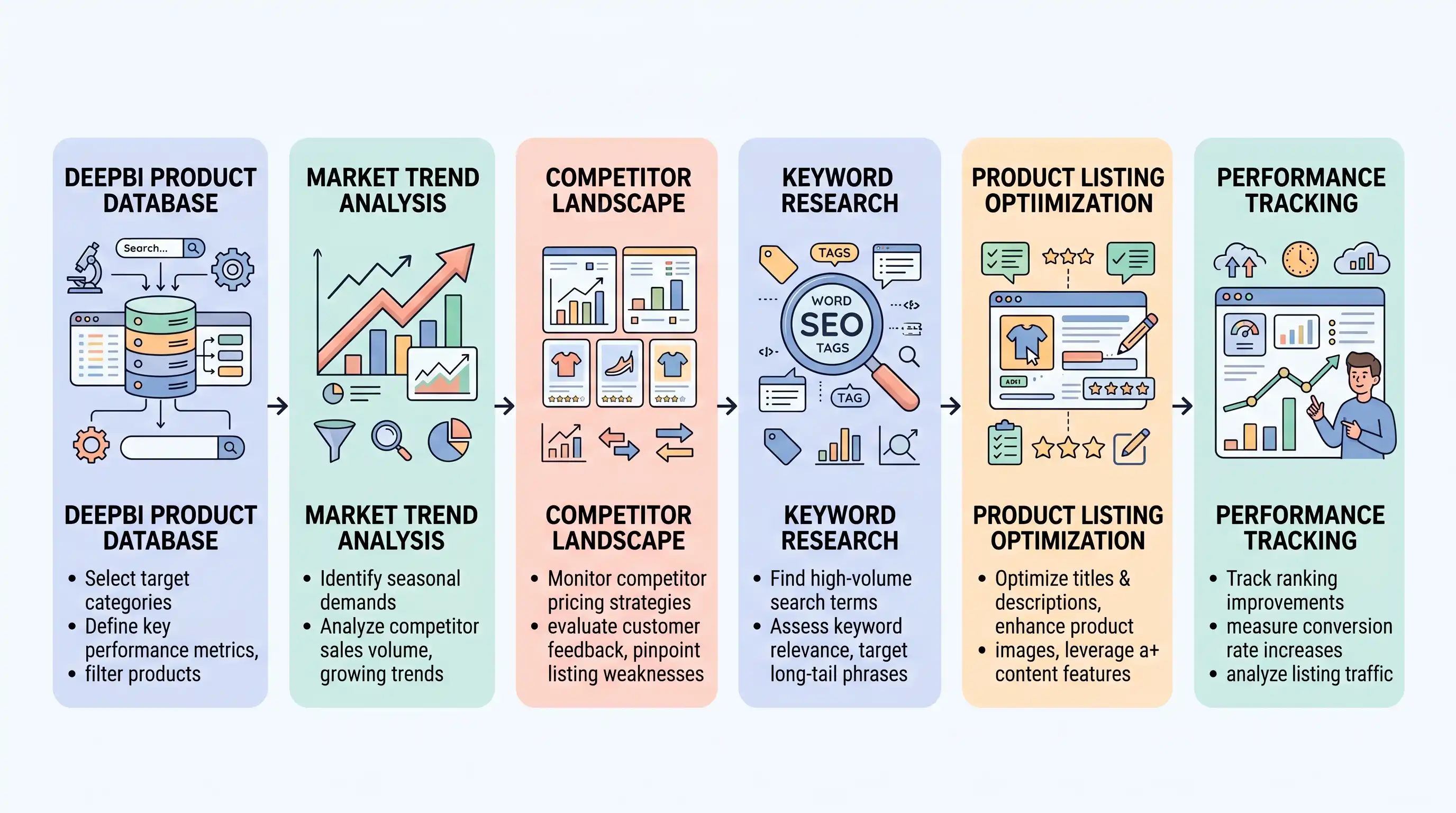
To eliminate blind trial-and-error in Amazon operations, DeepBI transforms listing optimization into an exact science. By utilizing AI-driven data evidence chains, sellers can transition from guesswork to precise, quantifiable improvements that directly impact core performance metrics like CTR, CVR, and BSR.The foundation of this strategy begins with DeepBI's Product Database, which is engineered to help sellers systematically find products ripe for evaluation and improvement. Users can pinpoint underperforming targets by applying strict filtering criteria: marketplace, categories, price, minimum sales, and Listing Quality Score (LQS). This targeted search ensures that sellers focus only on active ASINs with structural vulnerabilities, guaranteeing that optimization efforts will yield the highest return on investment and positively influence overall ACoS.Once a target product is identified, DeepBI deploys its intelligent scoring and multi-dimensional diagnostics capabilities. This system functions as an advanced diagnostic radar, meticulously identifying weak points across the entire listing architecture. By quantifying the gap between your listing and top-tier competitors, DeepBI provides highly deterministic, one-to-one mapping for necessary corrections. This closed-loop system seamlessly bridges the gap between market diagnostics and execution, enabling sellers to drastically reduce their listing cycle time while unlocking sustainable dual growth in both click-through and conversion rates.
Writing an Optimized Amazon Product Title
The product title serves as the primary data point for Amazon's A9 algorithm and the ultimate hook for customer engagement. When a seller launches a product, the title's keywords dictate exactly how the algorithm calculates product relevancy. A well-crafted title directly impacts your Click-Through Rate (CTR) and Conversion Rate (CVR) by ensuring your listing appears in front of highly qualified traffic. If the search engine cannot accurately parse your title's relevancy, your Best Sellers Rank (BSR) will suffer regardless of how much capital is deployed into advertising.
Amazon Listing Title Requirements
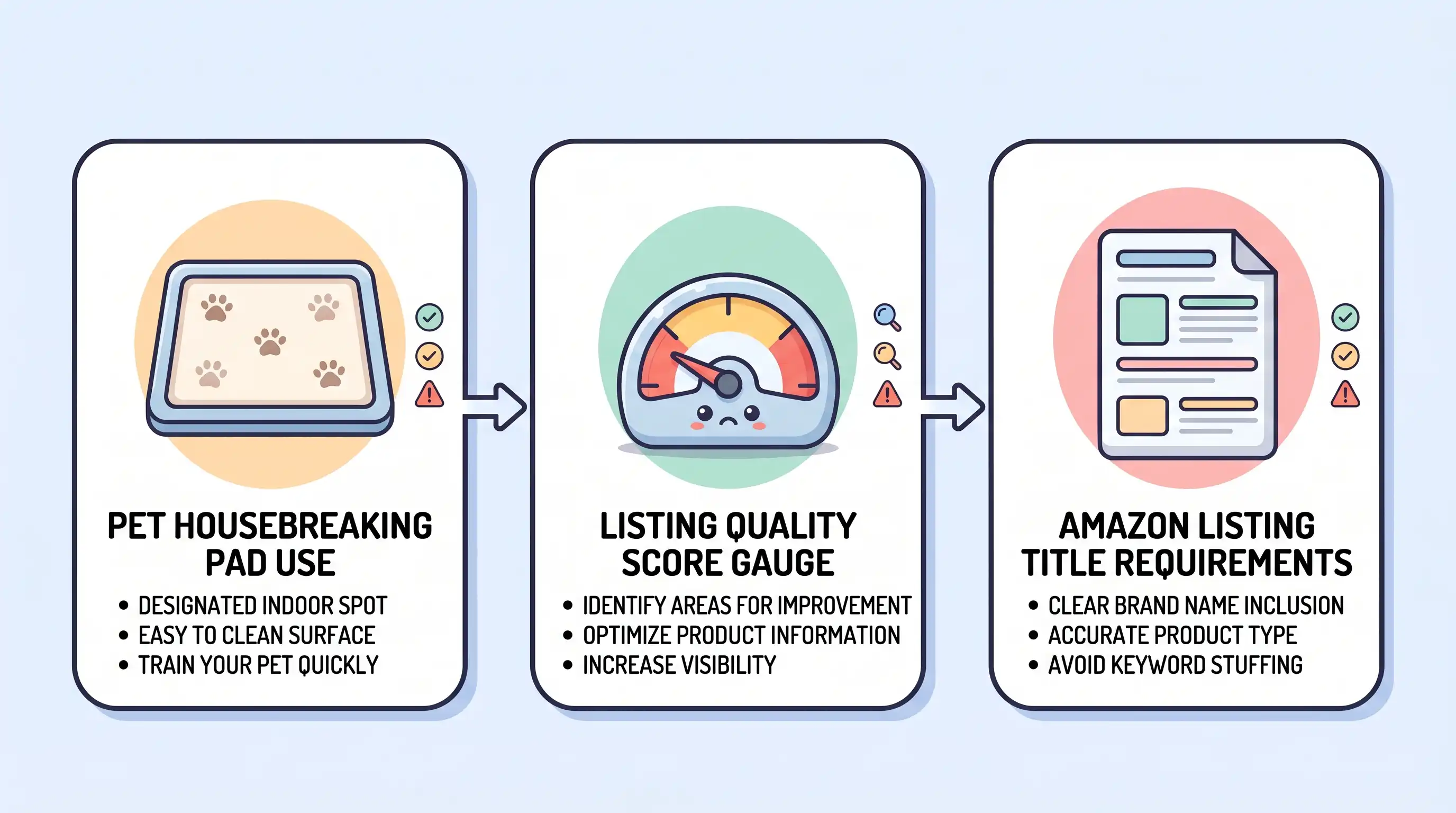
To maintain a high Listing Quality Score (LQS) and avoid search suppression, sellers must adhere strictly to Amazon's structural guidelines. First, the absolute character limit is capped at 200 characters. Second, disallowed special characters (such as !, ?, $, or ©) must be stripped entirely from the text. Finally, Amazon enforces strict keyword repetition rules—a keyword should not appear more than twice, barring specific grammatical exceptions.These structural rules act as a safeguard to prevent keyword stuffing, a manipulative tactic that harms CTR and inflates ACoS by confusing potential buyers. Consider a bare-bones title like "Pet Housebreaking Pad." This is a prime example of a poor title that yields an abysmal LQS. It fails to utilize the allowed character space, neglects essential long-tail search terms, and starves the algorithm of the semantic data required to confidently index the product in its bottom-level node.
A Good Amazon Product Title
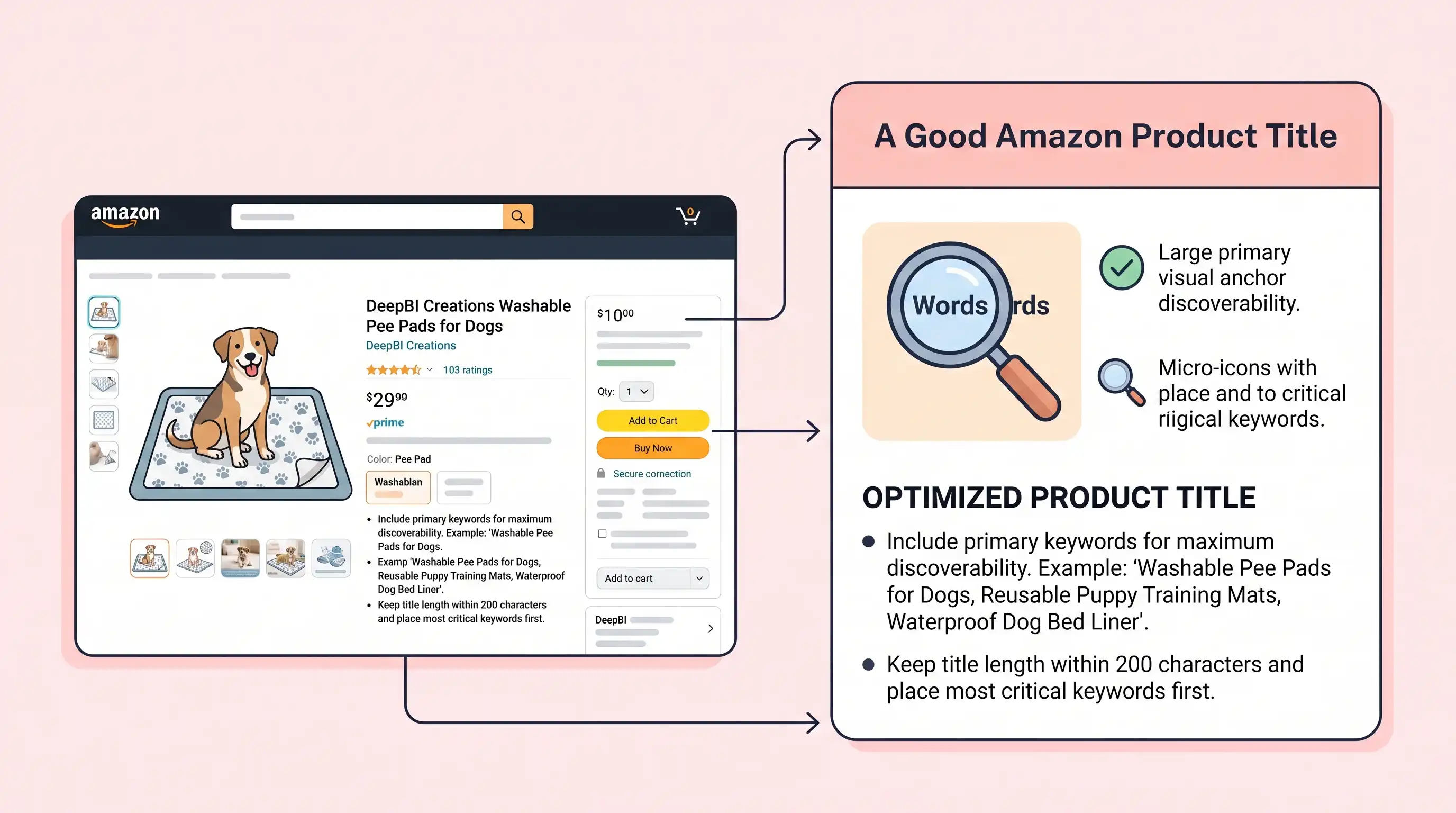
An expertly constructed title maximizes available character space while weaving critical product data into a highly readable format. A prime example of this balance is "DeepBI Creations Washable Pee Pads for Dogs." Unlike the previous weak example, this title is systematically optimized to drive CVR and improve the overall listing cycle time. To replicate this success, an optimized title must seamlessly integrate several key elements:* Target Audience: Clearly define who the product is for (e.g., "for Dogs").* Important Features: Call out core value propositions (e.g., "Washable").* Size and Product Quantity: Provide immediate logistical clarity to prevent buyer hesitation and minimize potential return rates.By utilizing the full 200-character allowance without resorting to keyword stuffing or violating keyword repetition limits, sellers can construct titles that align perfectly with multi-dimensional semantic matching algorithms. This precise structural alignment helps lock onto market benchmark competitors, ultimately stabilizing ACoS and defending search market share.
Writing Optimized Amazon Bullet Points
Amazon provides sellers with the allowance of up to five bullet points per standard product listing. Maximizing this allocation is critical for driving your CVR and improving BSR, as it allows you to utilize all available space to index high-value keywords and convey essential product details. Leaving any of these five slots empty surrenders valuable ranking real estate to your competitors.A severe error that negatively impacts conversion efficiency is simply copying the product title into the bullet points. This poor example of optimization wastes premium indexing space, degrades the shopper experience, and ultimately leads to unengaged traffic and a higher ACoS. To create compelling copy that actively converts clicks into sales, apply these fundamental structural tips to each bullet point:* Lead with Features and Benefits: Capture buyer attention immediately by front-loading the most critical advantage before diving into the secondary details.* Provide Detailed Explanations: Clearly articulate how the product functions, eliminating any ambiguity that could delay a purchasing decision.* Focus on Problem-Solving: Connect your product’s capabilities directly to the customer’s pain points, demonstrating exactly how the item resolves their specific challenges.* Include Vital Product Info: Embed necessary technical specifications, material details, and compatibility constraints to set accurate expectations and reduce return rates.* Prove Quality: Use highly compelling copy that anchors your claims in factual product attributes, building buyer confidence without relying on unsubstantiated marketing fluff.
Writing Optimized Amazon Product Descriptions
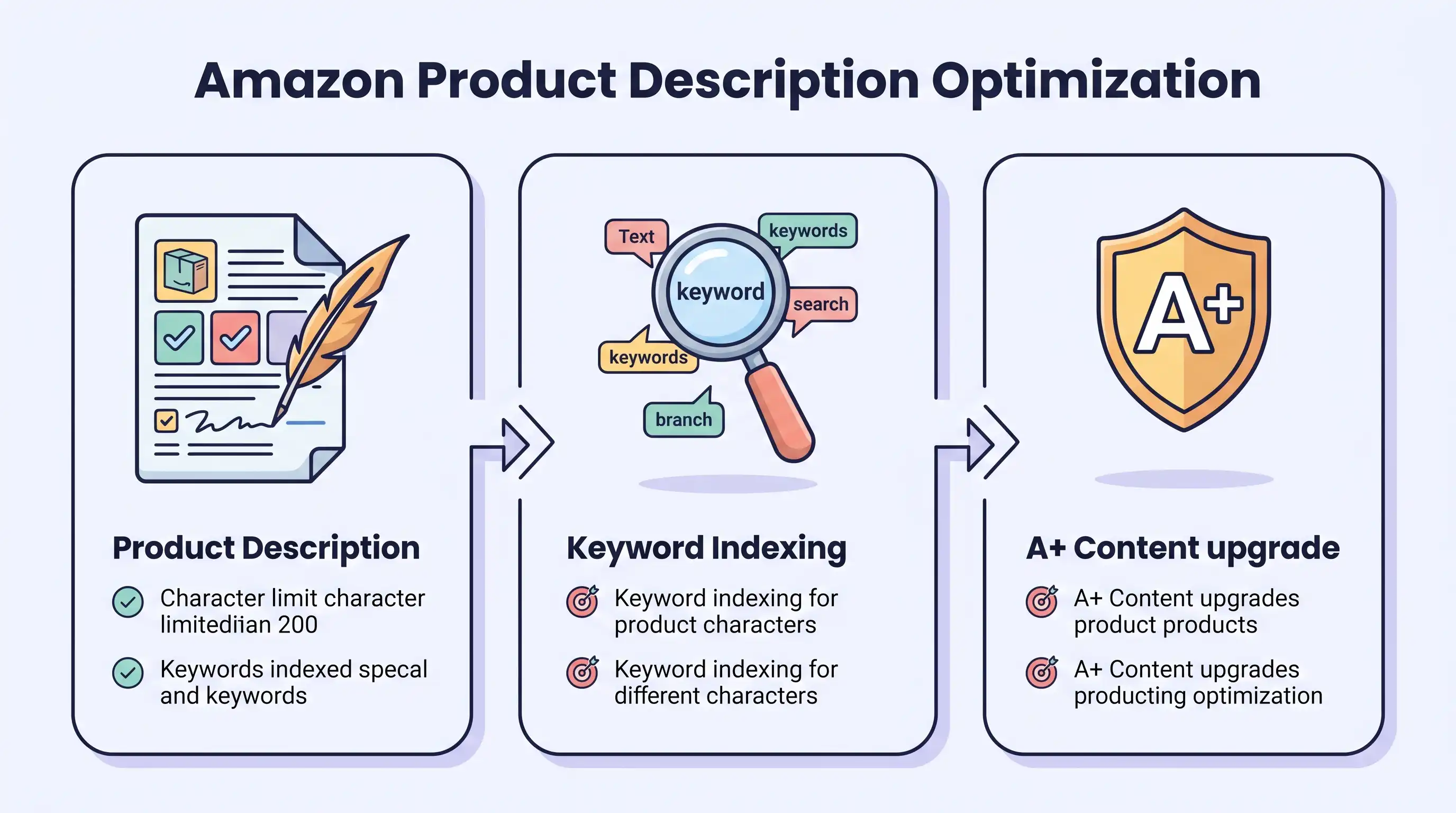
Located further down the detail page, the standard Amazon product description provides a critical opportunity to capture detail-oriented shoppers. This section allows up to 2,000 characters. Its primary purpose is to reiterate and expand upon the core features and benefits introduced in your bullet points, providing the narrative depth necessary to maximize CVR. Sellers must rely entirely on compelling copywriting and natural paragraph structure, as Amazon has officially discontinued the use of HTML tags for formatting in standard descriptions. Incorporating strategic keywords organically within this text remains vital for indexing and securing a higher BSR. For sellers enrolled in Amazon Brand Registry, standard text descriptions can be upgraded to A+ Content. This feature allows brands to deploy rich visual modules and enhanced formatting to build brand equity and aggressively drive conversion rates.
The Right Keywords (and How to Find Them) to Make Your Listing Rank
A successful keyword strategy must balance dual priorities: relevance and cost. High keyword relevance ensures your listing perfectly matches shopper search queries, which directly fuels organic indexing, search visibility, and CTR. However, cost is equally critical when transitioning these keywords into active PPC campaigns. Targeting highly relevant but prohibitively expensive keywords will inevitably inflate your ACoS. Sustainable optimization requires finding search terms that bridge the gap between high shopper intent and manageable advertising expenditures.
How to Find Good Keywords
Extracting actionable keyword data requires precision tools rather than guesswork. By utilizing DeepBI's Keyword Scout, sellers can initiate targeted searches based on general product types or by reverse-engineering specific competitor ASINs. The platform analyzes these inputs and provides three vital metrics for every search query: historical search volume, precise relevancy scores, and estimated advertising costs. This multi-layered data allows sellers to validate optimization points before spending ad budget, directly improving PPC efficiency and shortening the overall listing cycle time.······
Leverage the Power of DeepBI's Keyword Tools
DeepBI's Keyword Scout delivers a distinct competitive advantage by surfacing high-volume, affordable keywords that might otherwise remain hidden. Pinpointing these cost-effective search terms allows sellers to acquire aggressive market share while keeping ACoS under strict control. Once the optimal targets are identified, users can instantly add these terms to DeepBI's Keyword List. From there, the curated list offers easy import into the Listing Builder, ensuring your newly discovered keywords are seamlessly woven into the description without workflow delays.
How to Build a Product Listing That Converts
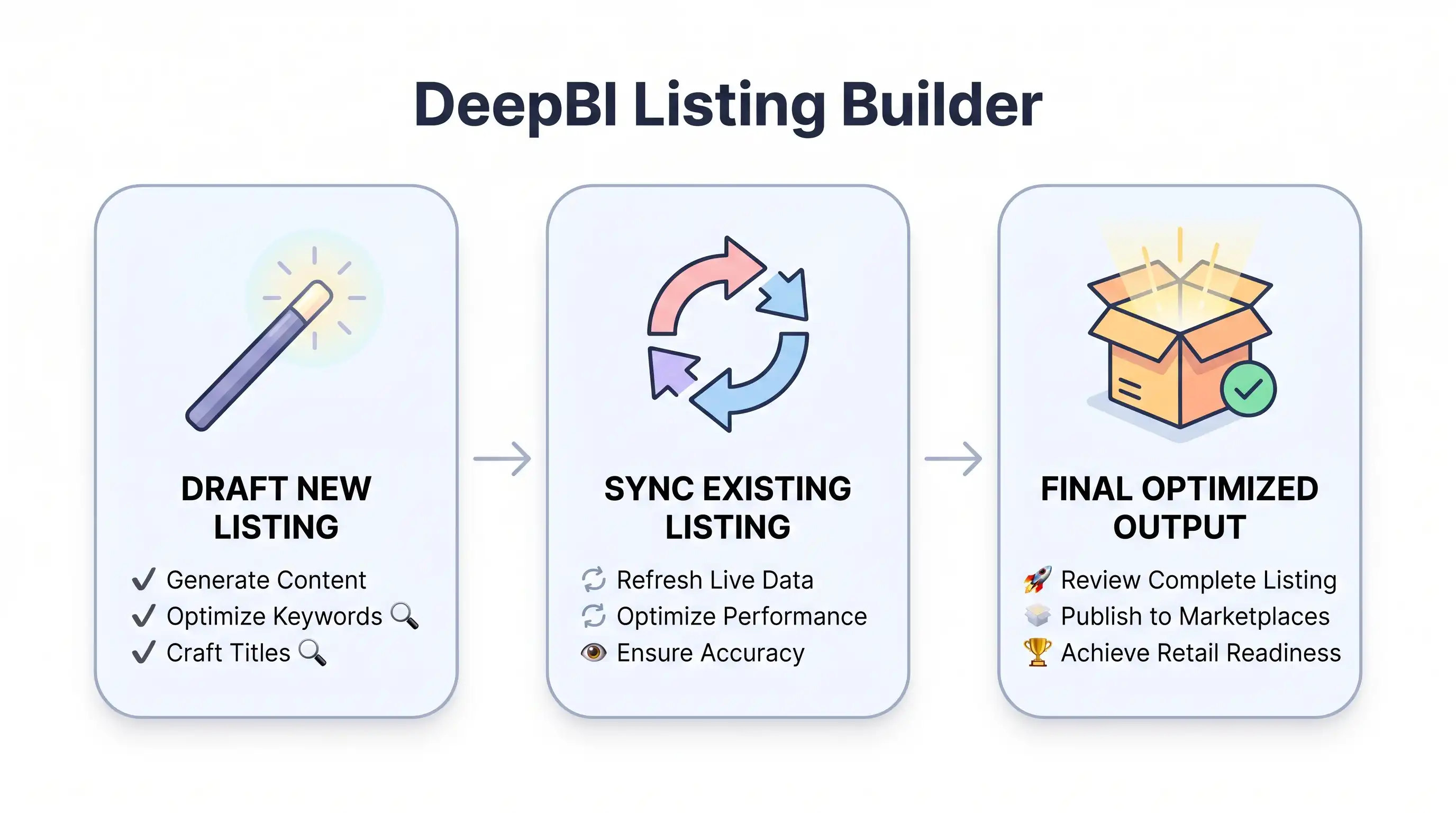
Achieving a competitive Best Sellers Rank (BSR) and maximizing your Conversion Rate (CVR) requires a systematic, data-backed approach to content creation. DeepBI’s Listing Builder acts as a centralized diagnostic radar, streamlining the optimization cycle to drastically reduce your overall listing cycle time. The tool simplifies the foundational steps of content generation by allowing sellers to either draft entirely new listings from scratch or seamlessly sync existing ones directly from Amazon Seller Central.
Once the foundation is established, the next critical phase involves precise keyword integration to drive traffic and improve Click-Through Rates (CTR). Users can easily import curated keyword lists directly into the system to guide the drafting process.
To maximize indexing efficiency, the Listing Builder automatically sorts these imported keywords by search volume, categorizing them into highest, medium, and lowest tiers. This structured hierarchy empowers sellers to prioritize high-volume root terms in the title while weaving medium-to-long-tail keywords into the bullet points and description. Sellers can manage this directly using the built-in content editor, which sits side-by-side with the active keyword list.
As you build your content, DeepBI deploys a real-time Listing Optimization Score. This data-driven metric quantitatively measures various listing elements—such as title density, bullet point structure, and keyword utilization—against high-performing competitors.
This score provides instant feedback for rapid adjustments, eliminating guesswork. Simultaneously, the system calculates and displays the potential monthly search volume captured as specific keywords are integrated into the text, ensuring optimization directly correlates with maximum traffic potential.
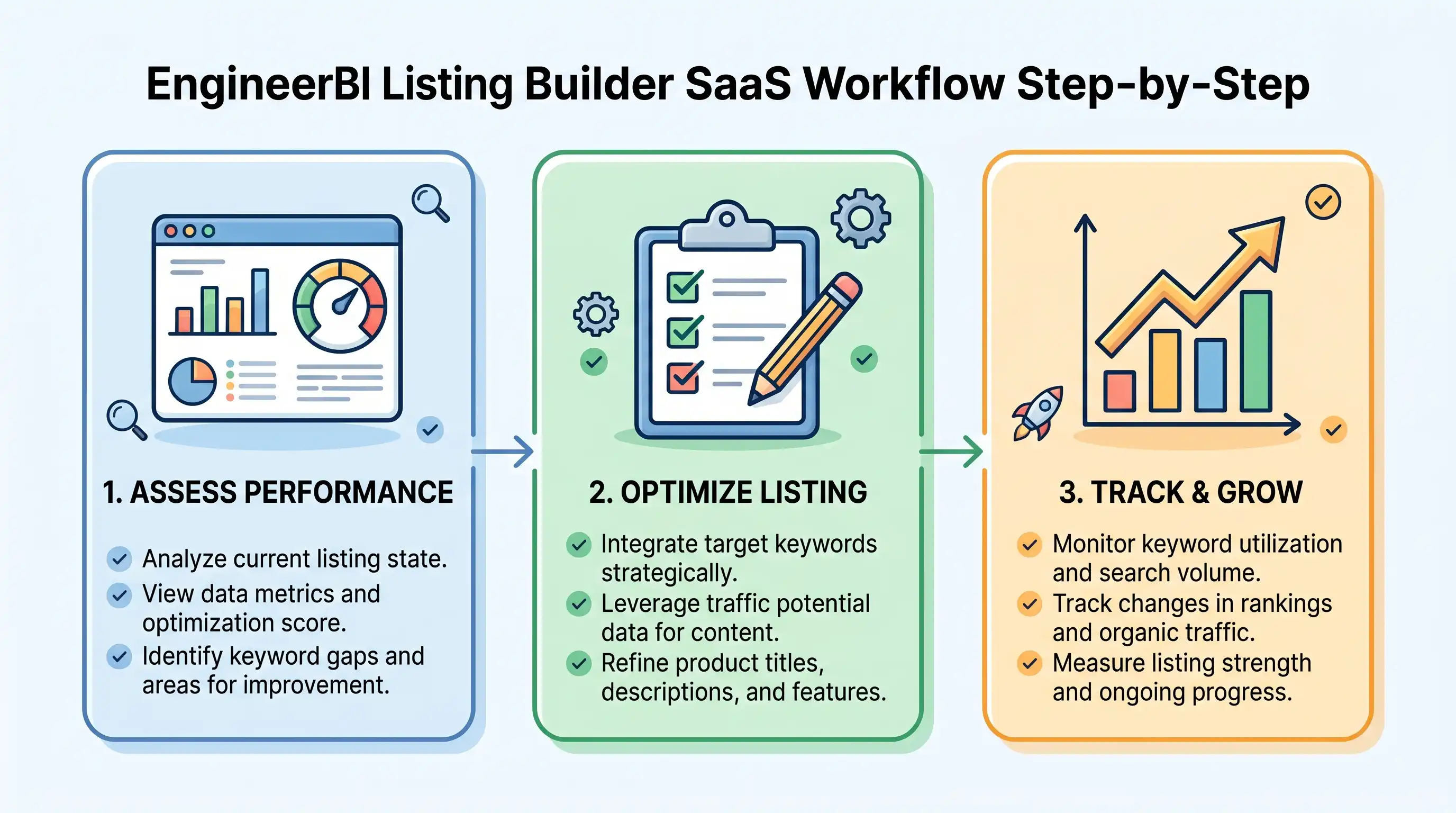
Execution speed is paramount for maintaining rank momentum. DeepBI features a one-click application function that synchronizes the newly drafted or updated listing directly back to Amazon Seller Central. This seamless integration finalizes the "analyze → generate → launch" workflow, removing operational friction and accelerating your path to improved ACoS and organic visibility.
Tips for Writing Effective Amazon Product Listing Titles
Crafting a compelling product title is foundational to driving traffic and improving core Amazon metrics. In the highly competitive marketplace, a well-optimized title directly influences your Click-Through Rate (CTR) and Best Sellers Rank (BSR) by aligning seamlessly with search algorithms and shopper intent. To maximize your listing performance, follow these proven title optimization strategies:* Prioritize Main Keywords: Place your highest-volume, most relevant keywords at the very beginning of the title. This ensures the search algorithm instantly recognizes the core product, significantly improving organic visibility and initial CTR.* Address Benefits and Features Concisely: Avoid blind keyword stuffing. Instead, integrate primary technical specifications and clear value propositions naturally into the text. Clear communication prevents buyer ambiguity, reducing immediate bounce rates and directly boosting your Conversion Rate (CVR).* Include Multiple Uses and Niches: Expand your market reach by incorporating secondary use cases or specific target demographics. Capturing these long-tail search queries helps acquire highly targeted traffic, which often converts at a higher rate and lowers your overall Advertising Cost of Sales (ACoS).* Leverage DeepBI's Optimization Suite: Eliminate subjective guesswork by utilizing advanced data tools. Start with DeepBI's Keyword Scout to conduct comprehensive market research and extract high-converting search terms. Then, deploy DeepBI's Listing Builder to seamlessly integrate those insights into your title architecture, drastically reducing your listing cycle time while ensuring exact algorithmic alignment.By systematically applying these strategies, sellers can transform their titles into precision instruments that capture high-intent traffic and accelerate growth.
Amazon Listing Optimization: Images
Product images, particularly the main image, serve as the primary driver for Click-Through Rates (CTR) on the search results page. When sellers experience climbing traffic costs alongside CTR and Conversion Rate (CVR) anxieties, the root cause often traces back to visual presentation. The January 31, 2024 Amazon update allows multiple selling partner images for hardline products. This policy shift creates an urgent motivation for sellers to optimize their visual assets or risk losing impressions to better-prepared competitors. To conquer these challenges, DeepBI offers advanced AI content and image generation capabilities. Sellers can use DeepBI to seamlessly transform their business strategies into precise prompts, generating high-converting main and detail images that bridge the CTR and CVR divide through data-backed evidence chains.
Image Requirements
Before focusing on aesthetics, sellers must ensure strict compliance with Amazon’s technical standards. To enable the critical zoom function—which directly impacts CVR by allowing shoppers to inspect details—images must have a minimum dimension of 1000px on the longest side. JPEG is the preferred file format for optimal listing loading speeds. Content restrictions are strictly enforced: images must contain no blur, nudity, or unauthorized Amazon logos and trust badges. A clear example of non-compliance is the KCHEX listing, which violates basic guidelines by offering a poor, unoptimized visual experience. Sellers must move past minimal uploads and maximize their visual real estate by using all available image slots—up to seven, including at least one video.
Good Product Images
A prime example of a high-converting visual portfolio is the "DeepBI Creations Washable Pee Pads for Dogs" listing. This product demonstrates how to properly execute a visual strategy. Every uploaded asset complies strictly with Amazon’s Terms of Service while fully utilizing the maximum allowed image slots. The highly informative secondary images systematically build trust in the detail page's trust endorsement module, explaining features clearly and leaving no ambiguities for potential buyers.
Amazon Product Photography Tips for Your Listing
To build a robust conversion funnel, sellers must strategically deploy all seven image slots. Ensure your image stack shows different angles, product packaging, detailed close-ups, lifestyle shots in realistic usage scenarios, and explanatory graphics. Always emphasize the 1000px minimum dimension so shoppers can seamlessly use the zoom feature. Use these supplementary images to actively explain the product's value proposition and proactively address customer objections before they hurt your CVR. Finally, because the main image dictates your top-of-funnel traffic, consistently split testing the main image is a required action to maximize CTR and lower overall ACoS.
Getting Positive Amazon Product Reviews
Positive reviews function as the ultimate social proof on Amazon, directly anchoring your listing's conversion rate (CVR) and Best Sellers Rank (BSR). When new shoppers click through to your product, a robust volume of highly-rated reviews provides the critical data evidence chain they need to finalize a purchase. Without this trust signal, even listings with a high click-through rate (CTR) will suffer from poor conversions and a climbing Advertising Cost of Sales (ACoS).To systematically build this social proof, sellers must implement reliable review generation strategies without violating platform policies. The foundational step is always creating an exceptional product that organically delights customers. Beyond product quality, you should utilize these compliant mechanics:- Rely on Amazon’s automated follow-ups: Amazon naturally sends post-purchase emails encouraging buyers to share their experiences.- Manually trigger requests: Sellers can click the 'Request a Review' button on individual order detail pages inside Seller Central to send standardized platform prompts.- Automate the process: To eliminate tedious manual clicks and optimize operational efficiency, leverage DeepBI's Review Automation for automated bulk requests. This ensures you consistently capture buyer sentiment while freeing up valuable listing cycle time to focus on broader growth strategies.
[Image: Screenshot of DeepBI's Review Automation tool showing review statistics for a product, positioned near Getting Positive Amazon Product Reviews]
Seller Feedback vs. Product Reviews
Sellers frequently confuse seller feedback with product reviews, but they serve fundamentally different purposes within the Amazon ecosystem. Product reviews are tied strictly to the ASIN, evaluating the physical item's quality, features, and performance—metrics that directly impact the product's CVR and search visibility. In contrast, seller feedback acts as a rating of the business entity itself, focusing on elements like customer service responsiveness and order processing. This distinction offers a distinct operational advantage for FBA (Fulfillment by Amazon) sellers. Because Amazon assumes full responsibility for fulfillment, shipping, and handling under the FBA model, any negative seller feedback explicitly related to logistics is beyond your control. If a buyer leaves a poor seller rating due to delayed shipping or transit damage, FBA sellers can successfully have that negative feedback removed. Promptly clearing these irrelevant metrics protects your seller profile and preserves your Buy Box win rate.
Take These Tips and Run With Them!
Investing time and resources into Amazon listing optimization is the fundamental driver of your marketplace success. Every adjustment made to your titles, bullet points, and visual assets directly impacts your listing cycle time and bottom-line metrics. As you move forward, consistently analyze your top competitors, keep a vigilant eye on emerging search trends, and employ best practices across your entire product catalog. This proactive approach ensures your product remains highly relevant to search algorithms and shopper demands. However, manual market analysis has its limitations when scaling a brand. To maximize efficiency, leverage DeepBI. DeepBI provides a robust, data-driven, automated, and closed-loop system for listing optimization. By utilizing continuous data feedback, strict similarity constraints, and automated competitor screening funnels, the platform transforms subjective, guesswork-heavy operations into precise, algorithm-driven decisions. Instead of relying on gut feelings, you can execute targeted, automated optimization plans that systematically boost your Click-Through Rate (CTR) and Conversion Rate (CVR) while actively improving your ACoS. The strategies and systems are now in your hands. Implement these precise optimizations, let data dictate your next marketplace moves, and watch your BSR climb as your listings achieve peak operational performance.
Learn More About Keyword Research and Automating Listing Optimization with DeepBI
As Amazon enters the deep waters of market competition in 2025, relying on manual processes is no longer viable. DeepBI provides a robust infrastructure for advanced keyword research and automated listing optimization solutions, entirely removing human uncertainty from your daily workflow. Rather than simply assigning arbitrary performance grades, DeepBI functions as a pre-diagnostic radar that captures vast amounts of real-time global market data. It then applies rigorous logical data cleaning and multi-modal diagnosis to build a definitive data evidence chain. This precise, data-driven methodology accelerates your listing cycle time while directly empowering foundational metrics, from driving higher CTR and CVR to stabilizing ACoS and scaling your BSR. By establishing an automated optimization framework, sellers can consistently deploy highly competitive product listings without workflow bottlenecks. Explore DeepBI to master advanced keyword research and streamline your operations through these core capabilities:* DeepBI Intelligent Optimization Suggestion System: Automate your listing refinements to eliminate manual guesswork and standardize high-converting keyword applications across your entire catalog.* DeepBI Pre-Diagnostic Radar: Utilize early-stage data capture to definitively structure your optimization roadmap prior to initiating visual or text generation modules.* DeepBI Global Market Data Capture & Intelligent Scoring: Establish a robust data evidence chain for targeted keyword research, ensuring every strategic listing update translates into measurable metric improvements.
About the Author: Brian Connolly
Brian Connolly is an Amazon seller, ecommerce expert, and writer for DeepBI.
Stay in the Amazon Seller Loop
Amazon’s ecosystem is highly dynamic, characterized by frequent algorithm updates, shifting compliance guidelines, and evolving search page features. Because the platform continuously refines how it connects buyers with relevant products, listing optimization is never truly a one-time task. Maintaining a competitive edge requires a commitment to ongoing education regarding marketplace shifts. The primary benefit of staying informed about Amazon selling is the ability to protect and improve baseline performance metrics proactively rather than reactively. When marketplace rules change, sellers who understand the latest developments can swiftly adjust their backend search terms, image formatting, and copy structure. This proactive adaptation directly shields your CVR from sudden drops and ensures your ACoS remains highly efficient despite algorithm turbulence. Furthermore, a sharp awareness of emerging optimization standards allows you to sustain a strong BSR while competitors scramble to understand why their organic traffic has stalled. Treating market awareness as a core business function prevents costly operational delays. Understanding the latest technical requirements immediately reduces your listing cycle time, eliminating the friction of unexpected compliance rejections or temporarily suppressed ASINs. Ultimately, ongoing vigilance transforms marketplace updates from operational threats into strategic advantages, ensuring your product catalog remains fully optimized, highly visible, and consistently profitable throughout the year.
Recommended Posts
Mastering Amazon listing optimization is a foundational step in scaling your business, but maximizing your overall performance requires a comprehensive approach across multiple operational pillars. To effectively protect your profit margins, drive continuous traffic, improve your Best Sellers Rank (BSR), and maintain a healthy Advertising Cost of Sales (ACoS), you must expand your strategies beyond the product page itself. Continuous learning is essential for maintaining a competitive edge, boosting your Click-Through Rate (CTR), and accelerating your overall listing cycle time from launch to profitability. To further enhance your brand’s operational efficiency and ensure long-term market dominance, explore the following resources:* Your Product Research Framework For Finding and Launching New Products* MAP Pricing Enforcement: How To Protect Your Brand on Amazon* 15 Proven Strategies To Increase Sales on AmazonBy integrating these advanced methodologies into your daily operations, you can bridge the gap between initial product discovery and sustained revenue growth. Combining elite listing optimization with rigorous pricing controls and proven sales tactics ensures that every click generated translates into maximum conversion value (CVR), helping your brand secure lasting marketplace authority.
Market Intelligence for Sellers
Sustaining long-term growth on Amazon requires more than just well-written copy; it demands continuous access to accurate market data. Without a clear understanding of shifting consumer search behavior, sellers risk wasting ad spend and losing visibility. To navigate this highly competitive landscape, relying on robust analytics is non-negotiable. This is where advanced analytics platforms step in. DeepBI provides industry-leading product and keyword data designed to help sellers sell smarter on Amazon. By accessing high-quality market intelligence, brand owners can transition from reactive guesswork to proactive strategy. Leveraging DeepBI’s precise keyword and product data directly impacts core performance metrics:* Targeting Precision: Accurate keyword data enhances listing and ad relevance, which helps drive up CTR and subsequently lowers ACoS.* Conversion Readiness: Understanding product trends allows sellers to tailor their listing content precisely to current buyer demands, directly lifting CVR.* Accelerated Execution: Reliable market insights drastically reduce the listing cycle time, enabling faster product launches and quicker optimization iterations.* Rank Stability: Continuous monitoring of product data supports aggressive yet calculated ranking strategies, essential for maintaining a dominant BSR over time. Ultimately, equipping your business with top-tier market intelligence ensures that every listing adjustment is backed by empirical evidence, securing a more profitable and resilient Amazon operation.