

Introduction
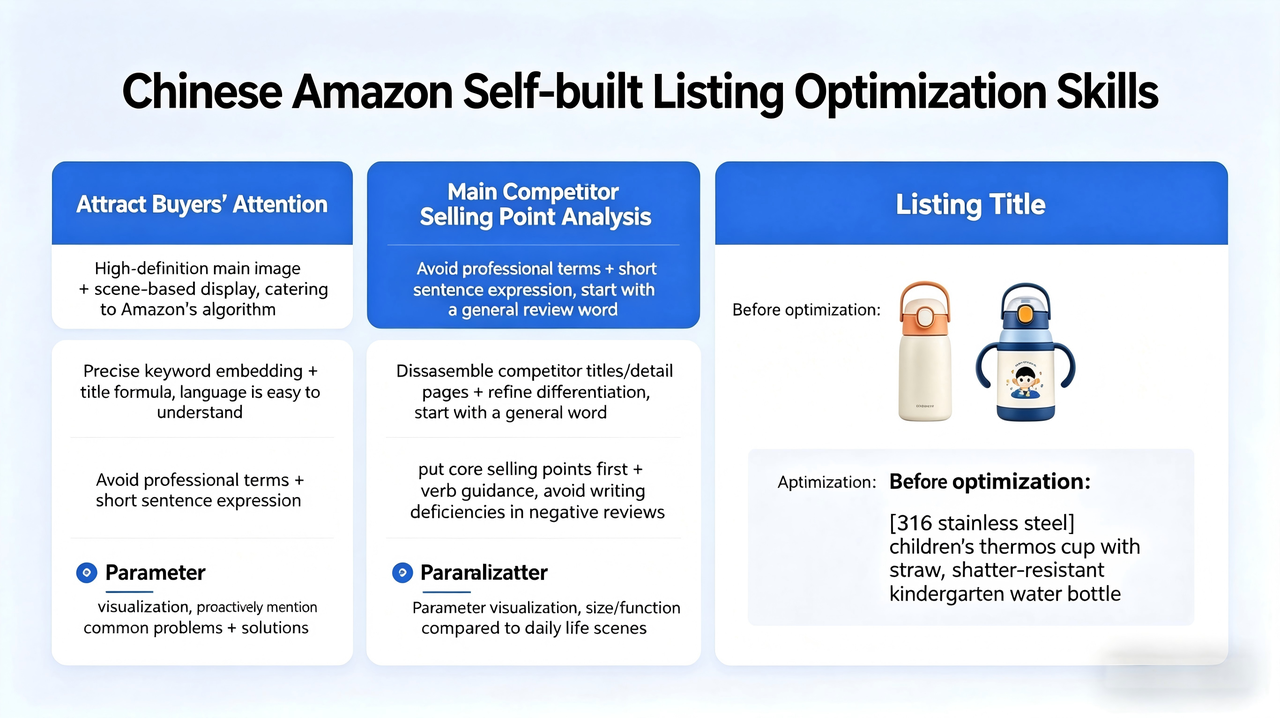
An Amazon listing is much more than a basic product page; it serves as a comprehensive storefront that directly influences complex shopper decisions and drives your baseline profitability. Operating within Amazon Seller Central’s shared catalog space requires sellers to supply accurate, keyword-rich, and well-structured information to compete effectively against millions of alternative products. By bridging the final mile between raw digital assets and immediate commercial value, this structured optimization approach ensures every catalog entry actively captures marketplace demand.
- Audit core traffic metrics continuously to pinpoint top-of-funnel leaks, specifically triggering a complete main image and title overhaul whenever your Click-Through Rate (CTR) falls below the critical 0.35% threshold.
- Diagnose the trust and persuasion funnel across your entire catalog, initiating an immediate restructuring of bullet points and visual assets if the overall Conversion Rate (CVR) consistently drops below the 7% baseline.
- Transform every individual product entry from a static data sheet into an immersive, highly curated storefront experience that systematically guides shopper decisions and actively lowers your Advertising Cost of Sales (ACoS).
- Map all backend search terms and frontend copy directly to Amazon Seller Central’s shared catalog guidelines, verifying that every single data field remains highly accurate, densely keyword-rich, and logically well-structured.
- Execute a systematic review of all performance reports to locate exact operational gaps, ensuring that every identified diagnostic flaw leads directly to a tangible, corrective execution step that shortens your listing cycle time.
- Implement precise visual localization strategies across international storefronts, utilizing culturally relevant environmental staging tailored to more than 20 global country sites to maximize regional shopper engagement.
- Standardize secondary image production with exact visual formatting rules, such as maintaining 60% product centrality, utilizing optimal 45-degree side-view angles, and integrating warm-toned background settings.
- Transition your internal optimization strategy from basic content creation to an advanced operational decision system, guaranteeing that all strategic visual upgrades and text improvements take immediate effect on the live marketplace.
- Streamline massive multi-SKU operations by deploying automated bulk iteration protocols, allowing large-scale sellers to update hundreds of visually outdated listings simultaneously while fundamentally reducing manual labor requirements.
- Track the direct correlation between localized content upgrades and your Best Sellers Rank (BSR) velocity, confirming that the systematic alignment of your optimization workflow actively translates digital asset improvements into immediate revenue.
The Amazon Listing Optimization Checklist (2026)
The following points are strictly backed by Amazon's documentation. DeepBI's AI-powered full-link optimization system provides a structured approach to guide Amazon sellers through each step of this checklist, from initial diagnosis to automated execution. Additionally, leverage DeepBI's competitor benchmarking feature to identify top-performing ASINs and set data-driven optimization baselines to systematically improve your listing performance.
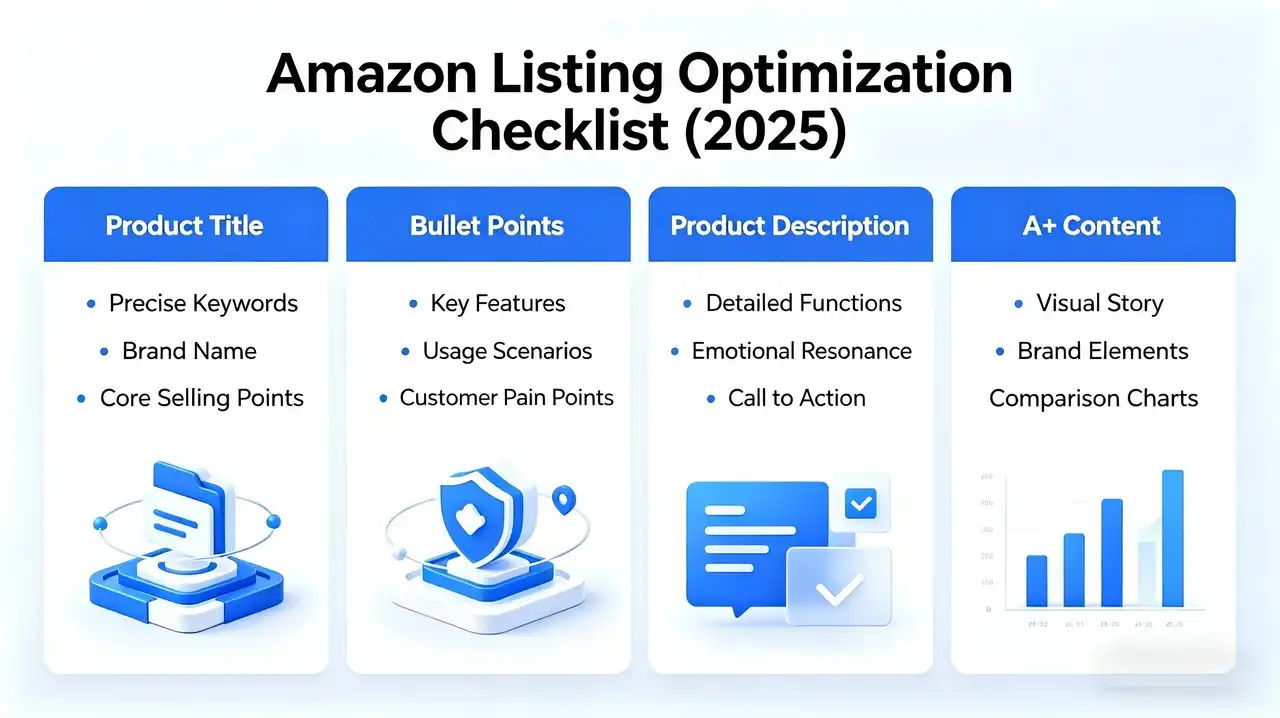
1. Product Title: Keep It Clear and Policy-Compliant
- Adhere strictly to category-specific character limits for optimal display and indexing.
- Include the brand, product type, and core features to improve initial CTR.
- Focus on avoidance of special characters and promotional phrases entirely.
- Guarantee natural keyword usage without search spamming.
- Example of a good title: "[Brand] Stainless Steel Mixing Bowl, 5-Quart, Non-Slip".
- Example of a bad title: "BEST BOWL EVER!!! Buy now for 50% off cheap".
2. Bullet Points: Make Them Clear and Benefit-Focused
- Focus on 5 short, scannable points to secure a high CVR.
- Start each line with capital letters and use no end punctuation.
- Mandate avoidance of emojis, all caps formatting, keyword repetition, pricing, and promotions.
- Emphasize a strict feature-benefit focus to demonstrate concrete value.
- Example: "Non-slip silicone base: Keeps the bowl securely planted on countertops during mixing"
3. Product Description: Keep It Natural and Informative
- Format text strictly in plain text, with the
<br/>exception being the only allowed HTML. - Maintain absolute simplicity and accuracy in your product messaging.
- Require strict avoidance of contact info, URLs, external links, quotes, testimonials, and promotional claims.
- Use this section specifically for product usage, secondary benefits, and secondary keywords.
- Example: Detail exactly how the tool integrates into a customer's daily routine to solve a common problem.
4. A+ Content: Tell a Stronger Brand Story
- Utilize A+ Content's role in delivering rich visuals, infographics, and brand stories to boost confidence and conversions.
- Add comparison charts and lifestyle images to visually educate the buyer.
- Implement strict avoidance of promotional claims, customer reviews, or direct competitor comparisons.
- Keep text simple and strictly follow module recommendations for mobile layouts.
- DeepBI Injection: Leverage DeepBI's AI content and image generation capabilities to produce high-conversion main images, detail images, and A+ content, ensuring visual assets are perfectly aligned with your product's DNA and brand story.
5. Product Images: Meet Amazon's Technical and Visual Standards
- Fulfill requirements for the main image: pure white background, 85% frame fill, no text/logos/watermarks, and 1000px+ on the longest side.
- Provide additional lifestyle and infographic images to engage shoppers and lift CVR.
- Include multiple angles, packaging shots, product-in-use scenes, and scale images to set accurate buyer expectations.
6. Product Videos: Boost Trust and Engagement
- Understand how videos boost trust and engagement, leading to more clicks and higher sales.
- Follow Amazon's recommendations: upload .mp4 or .mov formats and keep file sizes under 5GB.
- Focus exclusively on product usage, tangible benefits, and setup.
- Ensure total avoidance of contact info or promotional offers in voiceovers.
- Keep it short and impactful, adhering to a 30-90 seconds duration.
- Provide example video ideas: Quick unboxing, setup tutorials, or real-world demonstrations.
7. Keywords and Search Terms: Optimize Without Spamming
- Remember how keywords help Amazon algorithms accurately index and show products.
- Place primary keywords natively within your title, bullets, and description.
- Insert long-tail and marketplace-specific keywords into the backend.
- Ensure strict avoidance of repetition, banned terms, competitor brand names, and irrelevant search bait.
- Utilize Amazon’s Listing Enhancements Tool to surface critical missed terms.
- DeepBI Injection: Utilize DeepBI's intelligent scoring system, powered by multi-dimensional semantic benchmarking, to identify relevant, high-traffic keywords and naturally integrate them into your titles, bullet points, and backend search terms, maximizing discoverability on Amazon.
8. Pricing & Offer Optimization
- Note that price, condition, and shipping make up the offer, directly affecting Buy Box wins, customer trust, and Prime eligibility.
- Maintain fair pricing by accurately considering FBA fees and referral fees.
- Display accurate sale dates and guarantee consistent pricing across marketplaces.
- Establish strict avoidance of duplicate listings with different prices.
- Provide an example: Aligning FBM and FBA pricing perfectly for the same ASIN to maintain Buy Box health.
9. Product Variations: Keep Them Logical and Linked
- Ensure variations like sizes, colors, and flavors are fundamentally part of the same product family.
- Maintain a strict rule against grouping unrelated items.
- Follow Amazon's rules by using valid Parent-Child relationships.
- Remember that visual attributes must change images, while non-visual attributes do not.
- Respect strict variation limits capping at 2,000 child ASINs.
- Provide examples: Red and blue versions of a mug belong together; a mug and a coffee machine do not.
10. Compliance and Restricted Content: Stay Safe and Approved
- Focus heavily on avoiding contact details, external links, promotional text, and misleading claims.
- Emphasize routinely checking category and product guidelines to prevent suppression.
- Screen for prohibited content: misleading info, contact details, promotional/time-sensitive content, and restricted/offensive products.
- Secure necessary pre-approval for certain restricted categories before activating the listing.
11. Ongoing Optimization: Keep Monitoring and Updating
- Recognize that trends, keywords, and buyer behavior change continuously, requiring regular review.
- Dedicate time to checking performance, analyzing keyword traffic, and updating images/titles/prices.
- Utilize Amazon tools for monitoring: Review Listing Changes, Listing Quality & Suppressed Listing Report, Manage All Inventory, STEP Program & Brand Tools.
- Advise reviewing performance every 30-60 days and diagnosing issues based on impressions, CTR, and conversion rate.
- DeepBI Injection: Deploy DeepBI's intelligent scoring and multi-dimensional diagnostics to continuously monitor Amazon listings, identifying weak spots related to CTR and CVR and offering actionable strategies. Furthermore, leverage DeepBI's one-click application feature for seamlessly updating optimized content and AI-generated images directly to Amazon listings, streamlining the 'analyze → generate → launch' process.
What Happens If You Don't Follow a Listing Checklist
Investing extensive resources into visual and text overhauls without a standardized framework often traps sellers in a cycle of subjective guesswork, where core metrics inexplicably decline instead of growing. Relying on fragmented human experience or falling prey to survivorship bias when analyzing competitors leaves your strategic direction dangerously blurred. When you fail to quantify market gaps and skip a rigorous evaluation protocol, you expose your catalog to severe operational risks that actively sabotage your Click-Through Rate (CTR), Conversion Rate (CVR), and Best Sellers Rank (BSR).
- Suppressed Listings: Omitting mandatory category attributes, neglecting backend search terms, or failing to validate specific data points triggers Amazon's automated quality alerts, which instantly removes your product from active search results and drops your inbound traffic sessions to absolute zero.
- Low Organic Visibility: Skipping dynamic competitor benchmarking and precise keyword indexing leaves your product stranded on deep search pages, which suffocates organic impressions, forces you to rely entirely on paid traffic, and severely inflates your Advertising Cost of Sales (ACoS).
- Lost Buy Box Eligibility: Bypassing routine audits of your fulfillment metrics, pricing stability, and competitive offer landscape leaves your ASIN vulnerable to hijackers and performance flags, instantly stripping away your Buy Box ownership and halting your overall sales velocity.
- Negative Customer Experience: Deploying ambiguous copy or failing to clearly define the core product role in your main images creates a dangerous disconnect between buyer expectations and physical reality, which directly accelerates costly return rates and generates permanent negative reviews.
- Policy Violations: Disregarding Amazon's strict compliance guidelines regarding prohibited health claims, inaccurate guarantee statements, or restricted image elements invites severe algorithm penalties, escalating rapidly from temporary listing deactivations to catastrophic account suspensions.
Strictly adhering to an optimization checklist fundamentally prevents these operational disasters by transforming fragmented market insights into precise, actionable execution commands. By establishing a quantifiable baseline before executing any visual or text changes, you bridge the critical gap between initial market diagnostics and final implementation. Ultimately, a disciplined checklist approach guarantees that every optimization effort directly defends your listing cycle time, maintains flawless platform compliance, and engineers sustainable, long-term growth for your most critical performance KPIs.
Conclusion
An Amazon listing serves as a brand's definitive first impression and its most critical chance to secure a sale. In an increasingly saturated marketplace, your product detail page acts as both the digital storefront and the frontline sales representative. The foundational rule of e-commerce remains absolute: "Customers can only buy products they’re able to find." If a listing lacks the proper structural elements, backend keyword indexing, and high-quality visual appeal, even the most innovative product will languish in the depths of search results.
Mastering the 2026 optimization checklist means prioritizing full discoverability, driving better click-through rates (CTR), and maximizing conversion rates (CVR). The modern optimization process begins with rigorous multi-source data collection and utilizing automated competitive search funnels to identify precise market benchmarks within your specific bottom-level category node. By applying multi-dimensional semantic benchmarking, sellers can reverse-engineer top-performing titles and bullet points, ensuring that every text element aligns exactly with customer search intent. This strategic alignment increases organic traffic, reduces wasted ad spend, fundamentally lowers your Advertising Cost of Sales (ACoS), and steadily improves your Best Sellers Rank (BSR).
Furthermore, effective optimization bridges the gap between raw market intelligence and high-converting visual assets. Successful sellers translate unstructured market feedback and competitor data into strictly executable optimization directives. By applying these structured constraints to image creation and copywriting, brands ensure their visual assets perfectly match consumer expectations. This heavily influences CVR, as shoppers instantly recognize the product's value proposition through optimized hero images and rich detail pages. Beyond immediate performance metrics, consistent optimization secures long-term compliance and builds enduring shopper trust. Adhering to Amazon's latest structural guidelines prevents unexpected suppressions that disrupt sales momentum. Additionally, refining operational workflows—moving away from the tedious manual bottlenecks of downloading, renaming, and individually uploading visual assets—drastically accelerates the overall listing cycle time. This operational efficiency allows brands to deploy high-quality content faster and adapt to market shifts with agility.
Ultimately, continuous listing optimization is not a one-time setup but a sustained growth strategy. By ensuring maximum discoverability, delivering compelling narratives, and maintaining strict platform compliance, sellers position their catalogs for enduring profitability. Apply the principles from this checklist systematically, track your core metrics relentlessly, and transform your product pages into robust assets that dominate the marketplace.