

Introduction
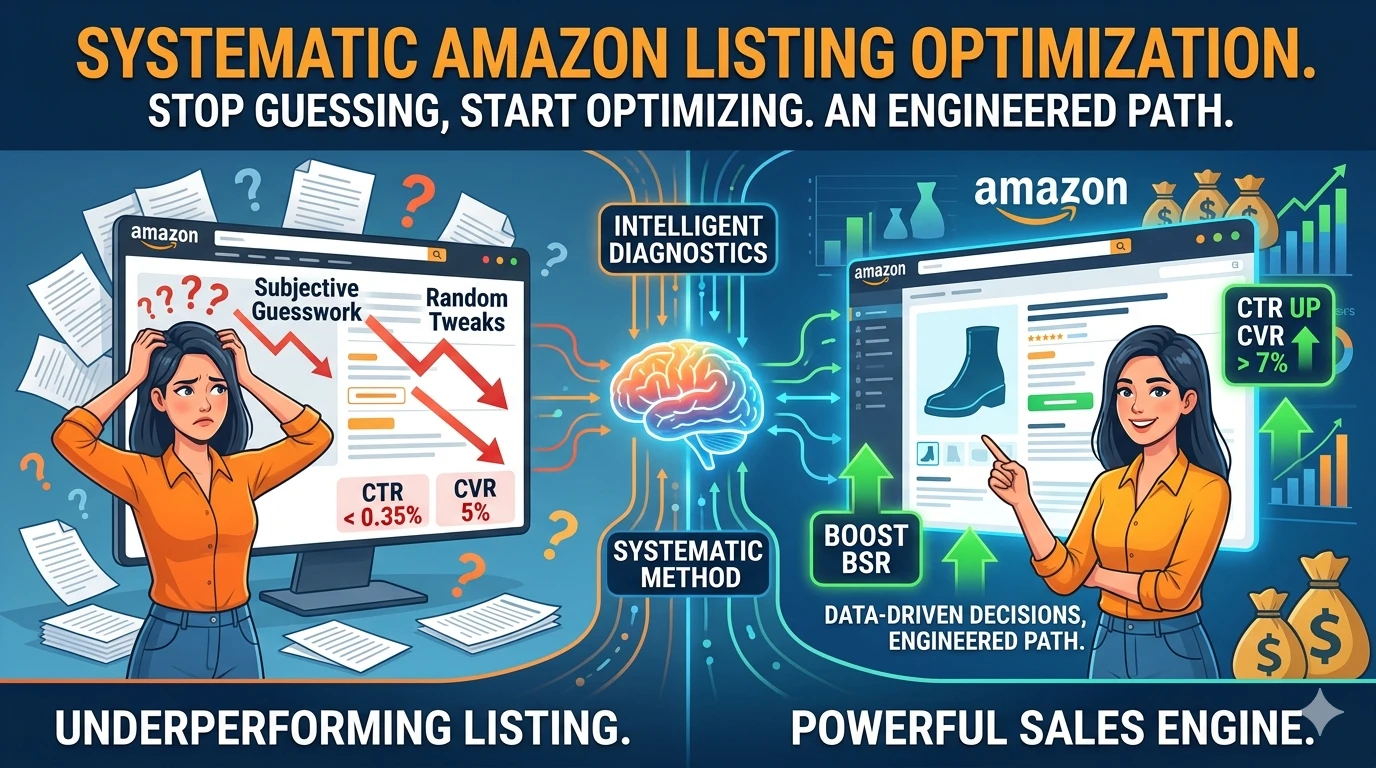
In the hyper-competitive Amazon marketplace, your product listing is the single most critical asset for driving visibility and sales. Yet, many sellers approach optimization with subjective guesswork, making changes based on intuition rather than data. This common misstep leads directly to business loss, manifesting in poor key performance indicators. When your Click-Through Rate (CTR) dips below 0.35% or your Conversion Rate (CVR) fails to exceed 7%, it’s a clear signal that your listing is underperforming and leaving money on the table.
The root cause is often the absence of a structured, analytical process for identifying and closing performance gaps against top competitors. To break this cycle of ineffective tweaks, you need to shift from random adjustments to a method of systematic optimization. This guide provides an engineered path to transform your listing from a static digital asset into a powerful sales engine. We will walk through a data-driven framework that uses intelligent diagnostics to pinpoint precise weaknesses, turning complex operational decisions into a clear, actionable roadmap for boosting your CTR, CVR, and ultimately, your Best Seller Rank (BSR).
What Is an Amazon Listing?
An Amazon listing is far more than a simple product page; it is your digital storefront, primary sales pitch, and competitive battleground rolled into one. This single page is the most critical touchpoint in a customer's journey, where their initial interest, sparked by a search query, must be converted into a confident purchase. Every element on this page serves a specific function in persuading both the customer and Amazon's A9 search algorithm.
The anatomy of a listing is a carefully structured collection of components, each directly influencing key performance indicators (KPIs):
- Product Title: This is the first point of contact in search results, acting as a primary driver for your Click-Through Rate (CTR). It must be keyword-rich for the algorithm and compelling for the human shopper.
- Images and Video: High-quality visuals are the most powerful tool for demonstrating value and building trust. They are the closest a customer can get to a physical product inspection and have the single largest impact on your Conversion Rate (CVR).
- Bullet Points (Key Product Features): These scannable, benefit-oriented snippets answer a customer's most pressing questions. A well-crafted set of bullet points can preemptively handle objections and significantly boost CVR.
- Product Description / A+ Content: This is your space for brand storytelling, detailed specifications, and overcoming complex purchase barriers. Enhanced A+ Content, in particular, can elevate brand perception and further improve conversion.
- Price and Shipping: These are fundamental decision-making factors. Competitive pricing and fast shipping options like Prime are critical for winning the Buy Box and closing the sale.
- Customer Reviews and Ratings: This is the social proof that underpins buyer confidence. A high star rating is a powerful conversion asset, while negative reviews can quickly depress your CVR and BSR (Best Sellers Rank).
Crucially, your listing does not exist in a vacuum. The page is also populated with sponsored ad placements from competitors, creating a constant threat of traffic leakage. If your listing fails to capture and convert a shopper's attention immediately, they are just one click away from a rival's product. This competitive pressure means that every component must work in concert, demanding a process of systematic optimization to maximize performance and defend your market share.

What Is Amazon Listing Optimization?
At its core, Amazon is a massive product search engine. Amazon Listing Optimization is the strategic process of tailoring every element of your product page—from keywords and titles to imagery and bullet points—to rank higher in its search results and persuade customers to buy. The goal is to align your listing with how both Amazon's A9 algorithm and human shoppers discover and evaluate products.
However, many sellers find themselves trapped in a cycle of ineffective updates. They invest significant resources in new photography or copy, only to see key metrics like Click-Through Rate (CTR) and Conversion Rate (CVR) stagnate or even decline. This often happens when optimization is driven by subjective aesthetics or an incomplete analysis of competitors, a process plagued by ambiguity and "survivor bias." Relying on human experience alone can lead to vague strategies, mismatched visuals that increase return rates, and ultimately, a negative impact on your Best Seller Rank (BSR).
In today's competitive marketplace, successful listing optimization is no longer about simple wordsmithing. It has evolved into a discipline that requires converting deep market insights into precise, AI-executable instructions. This shift demands a move away from guesswork toward a framework of systematic optimization. Instead of asking "Does this image look better?", the right question is "How can we adjust this image's composition, color profile, and background to measurably outperform the top three competitors for our target keyword?" This guide will walk you through this modern, data-driven approach, transforming your optimization efforts from an art of chance into a science of growth.
What Are the Benefits of Amazon Listing Optimization?
Effective Amazon listing optimization is a direct driver of sales velocity and profitability. By strategically refining your product title, bullet points, description, and images, you directly enhance your Amazon SEO, leading to higher search rankings and increased organic visibility. This improved discoverability boosts your click-through rate (CTR). Once shoppers land on your page, compelling copy and high-quality visuals work to increase the conversion rate (CVR). Furthermore, this systematic optimization clarifies product features and benefits, which improves customer satisfaction and reduces the frequency of negative reviews. Ultimately, these combined effects lead to a better Best Sellers Rank (BSR) and a stronger market position.
What Tools Should I Use for Amazon Listing Optimization?
In a competitive market defined by rising traffic costs, relying on manual processes and subjective judgment for listing optimization is a direct path to diminished returns. This approach often leads to a cycle of blind trial-and-error, negatively impacting key performance indicators like Click-Through Rate (CTR) and Conversion Rate (CVR). To move from guesswork to a data-driven strategy, sellers need an integrated toolset that provides an engineered path for systematic optimization.
DeepBI offers a comprehensive suite of tools designed to streamline the entire listing optimization workflow, from initial research to final publication. The process begins with a more intelligent approach to keyword discovery. Instead of just chasing high-volume terms, the system uses multi-dimensional semantic analysis to help you pinpoint market-leading competitors and identify the most relevant, high-intent keywords they rank for. This ensures your optimization efforts are grounded in proven market data from the start.
Once you have a validated keyword set, DeepBI’s listing builder helps organize these terms, eliminate duplicates, and structure your content logically. The platform then leverages AI to generate compelling titles, bullet points, and descriptions that are not only keyword-rich but also aligned with customer search behavior. This full-funnel logical alignment—from keyword strategy to final copy—is critical for improving your Best Sellers Rank (BSR) and lowering your Advertising Cost of Sale (ACoS).
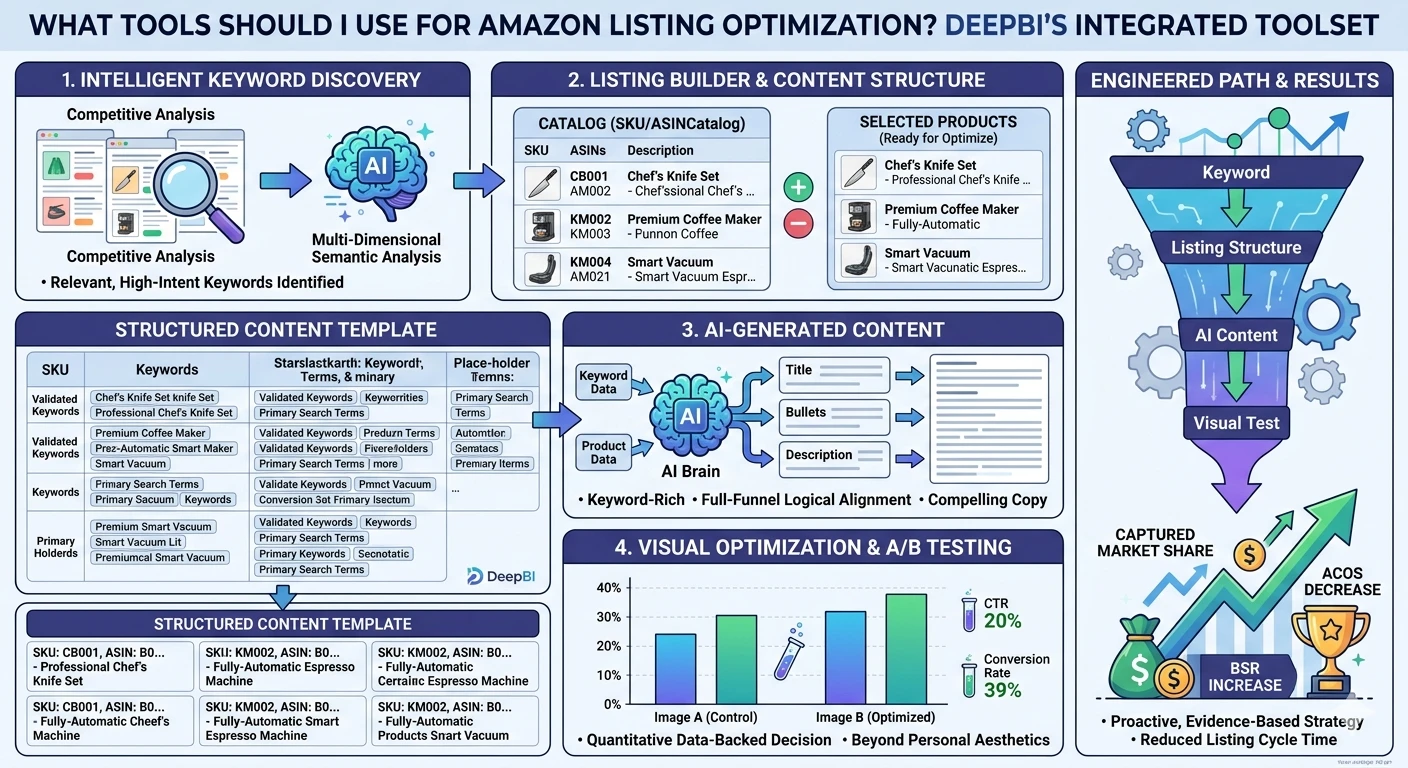
Finally, the platform addresses the critical, yet often subjective, element of visual appeal. DeepBI provides quantitative data and A/B testing capabilities for your main image and A+ Content. This allows you to move beyond personal aesthetic preferences and make data-backed decisions on which visuals will actually drive higher CTR. By automating the listing creation and synchronization process, DeepBI significantly reduces the listing cycle time, allowing your team to focus on strategic growth rather than manual data entry and content formatting. This shift from reactive adjustments to a proactive, evidence-based optimization process is what enables brands to capture market share more effectively.
What Is an Amazon Listing Quality Score?
Many Amazon sellers struggle to objectively diagnose why a listing underperforms. Without a clear framework, optimization becomes a cycle of guesswork, leading to wasted ad spend and stagnant sales. This reactive approach directly harms key performance indicators: a weak main image suppresses Click-Through Rate (CTR), unconvincing bullet points lower the Conversion Rate (CVR), and both contribute to a higher Advertising Cost of Sales (ACoS) and a poor Best Seller Rank (BSR).
The Listing Quality Score (LQS) is a proprietary metric engineered by DeepBI to solve this problem. It functions as a pre-emptive diagnostic radar, providing an objective, precise, and intelligent rating of your Amazon listing's competitive strength before you commit resources to optimization, especially AI-driven image generation.

Instead of a simple checklist, the LQS represents a comprehensive quantitative audit. The system establishes a "data evidence chain" by systematically analyzing and scoring every critical dimension of your listing, including:
- Main and secondary images
- Product title
- Five bullet points
- Product description
- Customer reviews and Q&A
Crucially, this score is not calculated in a vacuum. DeepBI’s architecture intelligently identifies and locks onto your key competitors, automating the otherwise tedious and error-prone process of manual comparison. It transforms the abstract landscape of market competition into a quantifiable score and a clear visual radar chart. This allows you to see, at a glance, exactly where your listing lags behind the top performers.
The entire diagnostic process is grounded in objectivity. The analysis is strictly based on comparing your product's "visible attributes" with the "visible advantages" of your competitors. The system is prohibited from inventing non-existent flaws or suggesting changes to your product's inherent properties like material, color, or industrial design. The LQS provides a reliable, data-driven foundation, creating a clear path for systematic optimization that targets the specific weaknesses impacting your Amazon KPIs.
How Many Keywords Are Allowed per Amazon Listing?
Amazon does not impose a specific numerical limit on the total keywords you can use across your entire listing. Instead, the platform's A9 algorithm prioritizes relevance and quality over sheer quantity. A strategy of simply stuffing as many keywords as possible will harm your listing's performance by confusing the algorithm and potential buyers. The most effective approach is a form of systematic optimization where keywords are placed strategically to maximize their impact on key metrics like Click-Through Rate (CTR) and Conversion Rate (CVR).
Key areas for keyword placement have their own constraints and best practices:
- Title: This is the most heavily weighted field for search ranking. Integrate your top 1-3 keywords naturally to capture the most relevant traffic.
- Bullet Points & Description: Weave in secondary and long-tail keywords to address specific customer questions, features, and use cases. This helps improve relevance for a wider range of search queries.
- Backend Search Terms: This is the primary field with a hard character limit—you must stay under 250 bytes (not characters). This space is intended for relevant search terms that you couldn't fit naturally into the visible parts of the listing. Do not repeat keywords already present in your title or other prominent fields.
Focusing on relevance over volume ensures you attract qualified traffic, which is essential for improving your listing's CVR and, ultimately, its Best Seller Rank (BSR).
How Do I Choose the Best Keywords for My Amazon Listing?
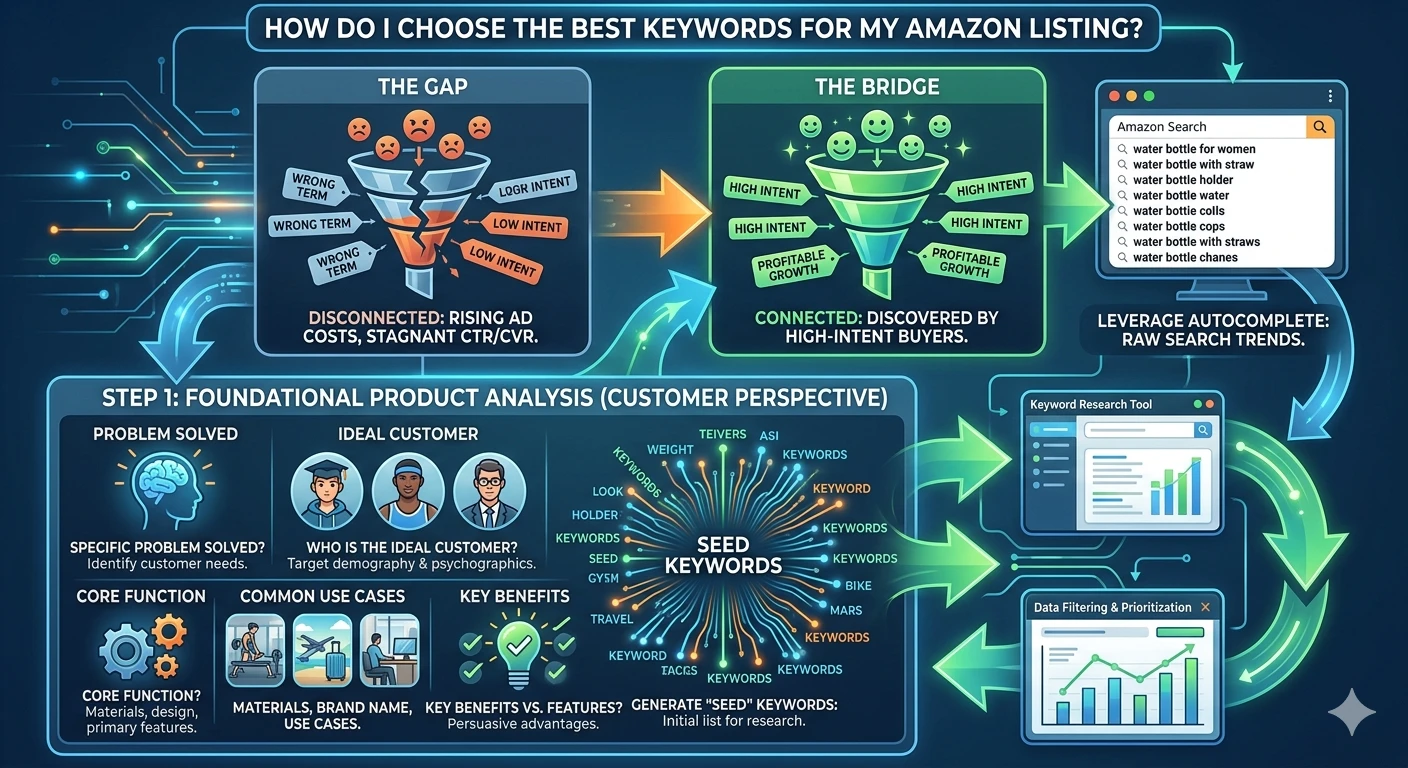
In an increasingly competitive Amazon marketplace, many sellers are facing the dual pressures of rising advertising costs and stagnating click-through rates (CTR) and conversion rates (CVR). The root cause often lies not in the product itself, but in a disconnect between the listing and what customers are actually searching for. Effective keyword selection is the foundational step to bridge this gap, ensuring your product gets discovered by high-intent buyers.
Moving beyond guesswork requires a data-driven process. Here is a systematic approach to identifying and prioritizing the keywords that will drive profitable growth.
1. Start with Foundational Product Analysis
Before diving into any tool, deeply understand the product from the customer's perspective. What specific problem does it solve? What are its key features and benefits? Who is the ideal customer? Brainstorm a list of "seed" keywords based on the product's core function, materials, brand name, and common use cases. This initial list forms the basis for all subsequent research.
2. Mine Amazon's Search Bar for Real-Time Customer Intent
Amazon's search bar is your most direct source of customer intelligence. Begin typing your seed keywords and observe the autocomplete suggestions that appear. These are not random phrases; they are the most frequent and recent searches related to your initial term, reflecting genuine customer demand. This simple method is invaluable for uncovering high-intent, long-tail keywords that indicate a buyer is further along in their purchase journey.
3. Reverse-Engineer Top Competitor Listings
Identify the top 5-10 listings that consistently rank on the first page for your most important seed keywords. Manually analyze their titles, bullet points, and product descriptions. What common keywords and phrases do they use? Pay close attention to the language they employ to describe features and benefits. This analysis reveals terms that Amazon's algorithm already considers highly relevant and that have proven effective at driving traffic and sales for your competitors.
4. Conduct a Quantitative Audit with a Keyword Research Tool
While manual research provides qualitative insights, a tool like DeepBI is necessary for a full quantitative audit. Instead of manually collating data, you can systematically analyze a broad set of potential keywords against critical performance metrics. A powerful tool allows you to:
- Validate Search Volume: Prioritize keywords that have sufficient search traffic to impact your sales.
- Assess Competition: Identify keywords with high search volume but lower competition, representing untapped opportunities.
- Determine Relevancy Score: Ensure the keywords are directly related to your product to maximize CVR and minimize wasted ad spend, which directly improves your ACoS.

5. Categorize, Prioritize, and Integrate
With a comprehensive list validated by data, the final step is to structure it for implementation. Group your keywords into three categories:
- Primary Keywords: The 2-3 most critical, high-volume, and highly relevant terms. These must appear in your product title.
- Secondary Keywords: Important terms that describe key features or use cases. These should be integrated naturally into your bullet points and description.
- Long-Tail Keywords: Longer, more specific phrases that capture high-intent searches. These are perfect for your backend search terms and for informing your PPC campaign structure.
This structured approach transforms keyword selection from a guessing game into a process of systematic optimization, creating a powerful foundation for your entire listing strategy.
How Do You Optimize an Amazon Product Listing?

Optimizing an Amazon listing is not a one-time task but a systematic process of refining every element on your product detail page. The goal is to improve visibility in search results, increase click-through rates (CTR), and maximize conversion rates (CVR). This requires moving beyond intuition and implementing a quantitative audit of your listing against top competitors. Data-driven tools like DeepBI's Listing Analyzer provide the necessary diagnostics, while the Listing Builder helps execute the improvements, creating an engineered path to better performance.
Product Title
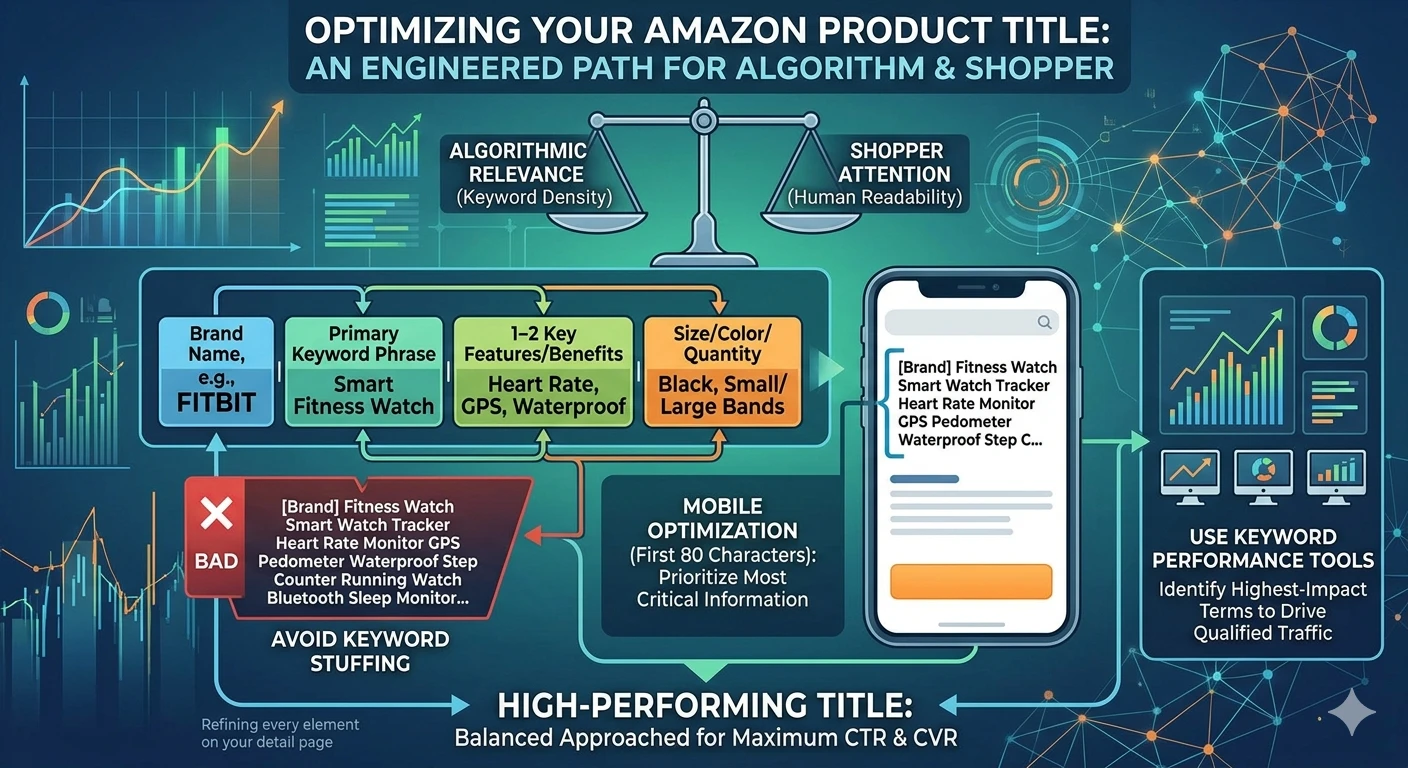
The product title is your most powerful tool for capturing both algorithmic relevance and shopper attention. A high-performing title balances keyword density with human readability. Structure it logically: Brand Name + Primary Keyword Phrase + 1-2 Key Features/Benefits + Size/Color/Quantity. Prioritize the most critical information within the first 80 characters for mobile optimization. Avoid keyword stuffing—jamming in keywords unnaturally—as it harms readability and can be penalized by Amazon. Use tools that track keyword performance to identify the highest-impact terms that will drive qualified traffic.
Bullet Points
Your five bullet points are your quick sales pitch. They should be benefit-driven, not just a dry list of features. Start each bullet with a capitalized, compelling phrase that answers the customer's core question: "What's in it for me?" For example, instead of "100% Cotton," write "BREATHABLE COMFORT: Made from 100% pure cotton for all-day wear." This is the ideal place to naturally integrate secondary keywords you couldn't fit in the title. Well-crafted bullet points preemptively address customer questions, building confidence and directly improving your CVR.
Description
The product description is your opportunity for deeper storytelling and SEO reinforcement. Use this space to expand on the benefits mentioned in the bullet points, share your brand story, and address any complex features or use cases. While fewer customers read the full description compared to the bullets, it's heavily indexed by Amazon's search algorithm. Ensure your primary target keywords are included here in a natural, narrative format to strengthen your listing's relevance for those search terms.
Enhanced Brand Content (A+ Content)
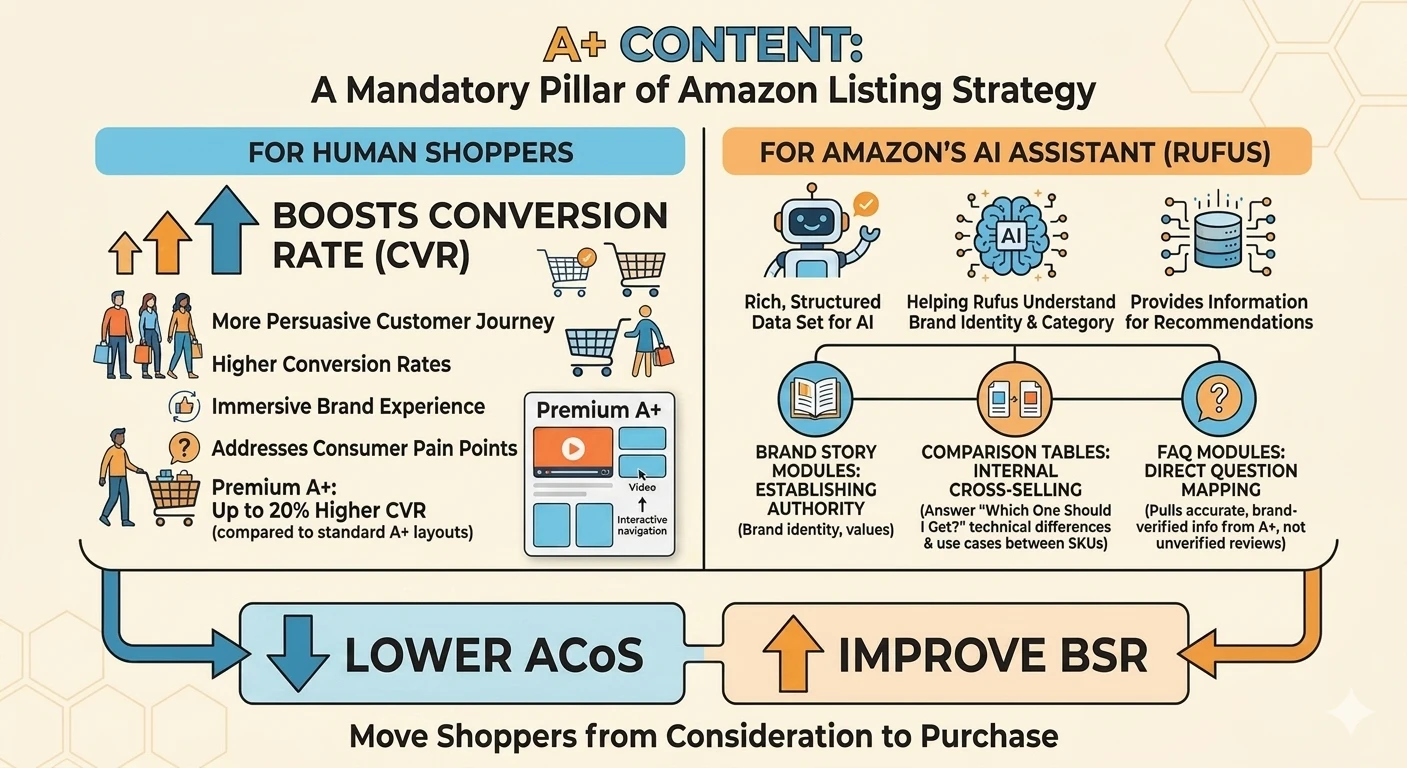
For sellers enrolled in Amazon's Brand Registry, A+ Content replaces the standard product description with a visually rich experience. It allows you to use high-quality images, comparison charts, and expanded text modules to tell a compelling brand story. This enhanced presentation significantly boosts CVR by building trust and better communicating product value. Strategically, A+ Content also pushes competitor sponsored product ads further down the page, keeping shoppers focused on your offer.
Images
Images are arguably the most critical factor for both CTR and CVR. Shoppers can't touch your product, so your images must do all the work.
- Main Image: This is what shoppers see on the search results page. It must comply with Amazon's strict rules, featuring the product on a pure white background. A professional, high-resolution main image is non-negotiable for earning the click.
- Secondary Images: Use a mix of infographics to call out key features and dimensions, and lifestyle images to show the product in a real-world context. This helps customers visualize the product in their own lives, answering unasked questions and overcoming purchase hesitation.
Continuously A/B testing your image gallery using data analytics tools is essential for systematic optimization to find the combination that yields the highest conversion rate.
Search Terms
This is a hidden, backend field where you can input keywords that don't fit naturally into your visible listing copy. Use this space for synonyms, common misspellings, related concepts, and even foreign-language terms relevant to your audience. Do not repeat keywords already present in your title, bullets, or description. Simply separate terms with a space; no commas or semicolons are needed. This field is a pure SEO play to broaden the range of queries your product can be indexed for.
Subject Matter
The Subject Matter field is another backend tool that helps Amazon's A9 algorithm accurately categorize your product. It functions like a set of specific, targeted keywords that refine your product's classification. Populating these fields with your most relevant, high-performing keywords provides Amazon with clear signals about your product's niche, improving indexing accuracy and ensuring you appear in the most relevant search results.
Reviews
Product reviews are the ultimate form of social proof and have a direct, powerful impact on your CVR. Listing optimization extends to review management. It's not just about getting more reviews, but about actively managing them. Use tools like DeepBI to monitor customer feedback, allowing you to quickly address negative reviews to mitigate damage and thank customers for positive ones. More importantly, analyzing review data can reveal common issues or desired features, providing invaluable insights for product and listing improvements.
What Are Other Factors That Impact Amazon Listing Performance?
A perfectly crafted listing is foundational, but its performance is deeply interconnected with other critical business levers. Your fulfillment method—FBA or FBM—and shipping speed directly influence Prime eligibility, a key driver of conversion rates (CVR) and Best Seller Rank (BSR). A dynamic pricing strategy is essential for winning the Buy Box and staying ahead of competitors. Furthermore, the intensity of the competitive landscape sets the baseline for performance. Finally, your Amazon PPC campaigns rely on a strong listing to convert paid traffic efficiently, directly impacting your Advertising Cost of Sale (ACoS). True success requires a systematic optimization approach that considers all these elements in concert.
Conclusion
Thriving on Amazon is no longer about isolated tactics; it's about building a cohesive growth engine. The most successful listings are born from a powerful synthesis of creative copywriting, deep market research, and precise keyword implementation. This process requires moving beyond intuition and establishing a data evidence chain that informs every decision, from title construction to backend search term selection.
Tools like DeepBI provide the foundation for this modern approach. By creating an automated competitor analysis funnel and leveraging a collaborative matrix of specialized AI agents, you can execute a truly systematic optimization of your listings. This engineered path ensures that every element is aligned to improve key metrics like CVR and BSR, transforming your product pages from static digital shelves into dynamic sales drivers.
Accelerate the Growth of Your Business, Brand or Agency with DeepBI
Navigating the Amazon marketplace successfully requires moving beyond intuition and embracing a data-driven, systematic optimization process. The gap between analyzing market data and executing creative changes is where potential revenue is lost, leading to lower CTR, suppressed CVR, and a stagnant Best Sellers Rank (BSR). This is the operational friction that slows down growth for sellers, brands, and agencies alike.
DeepBI is engineered to close this gap. It is not merely a scoring tool but a complete growth engine built on a foundational principle: rigorous diagnosis must precede strategic action. Our platform functions as a pre-emptive diagnostic radar, conducting a quantitative audit of your listings against real-time global market data. We believe the core of effective diagnosis isn't a superficial score but a robust "data evidence chain" that reveals precisely why and where your listing underperforms against key competitors.
Our system provides an engineered path from insight to impact through four distinct modules:
- Smart Scoring (Diagnosis): We capture and analyze vast market data to build an objective, evidence-based performance baseline.
- Optimization Suggestions (Strategy): The system translates complex diagnostic findings into clear, actionable strategic recommendations.
- AI Generation (Production): These strategies are converted into precise instructions for our AI engine to generate high-fidelity text and visual assets tailored to market demands.
- One-Click Application (Delivery): Deploy your optimized content directly, minimizing friction and accelerating your listing cycle time.
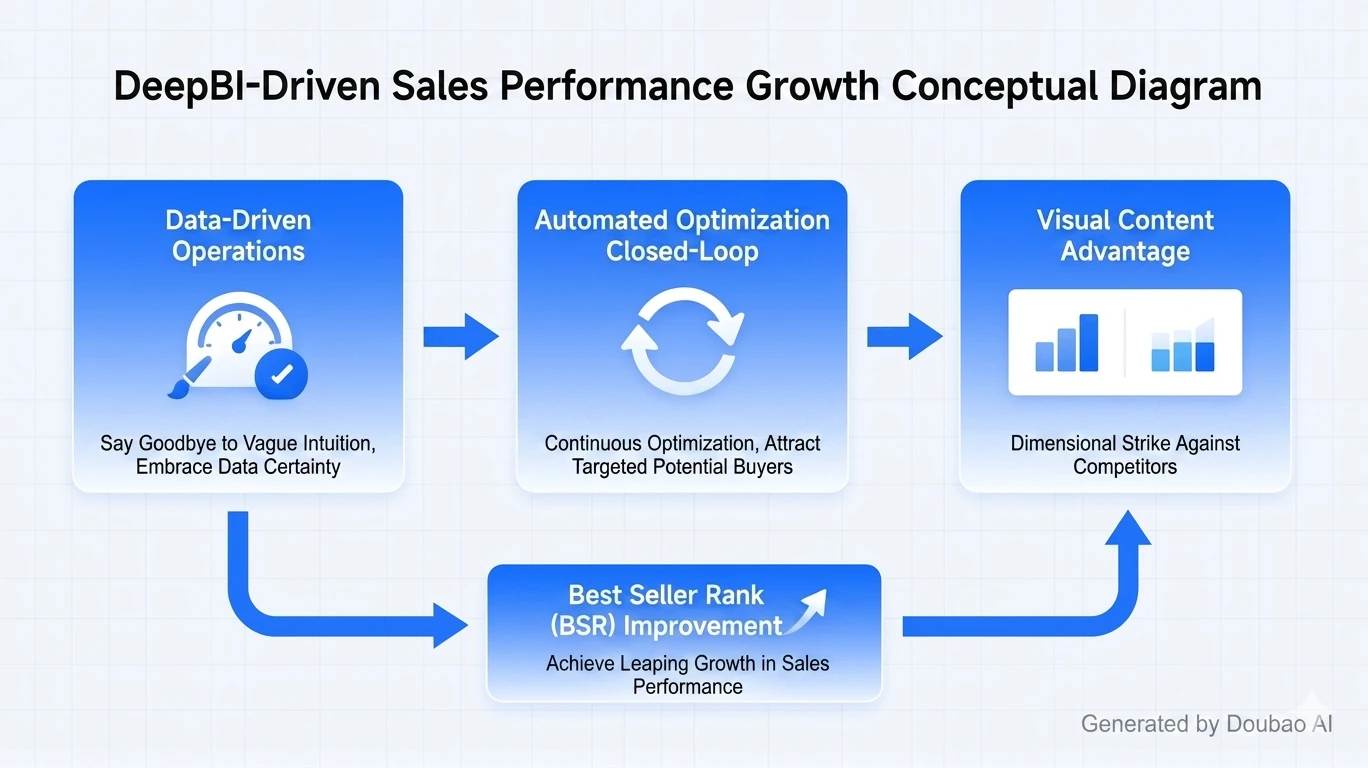
This seamless integration eliminates the human uncertainty that often derails optimization efforts. By transforming data directly into high-performing assets, DeepBI ensures your Amazon SEO and listing elements are not just creative, but strategically engineered to win clicks, drive conversions, and scale your business.
Stop guessing and start growing. It's time to implement a system that connects every optimization decision to a clear data point and a measurable business outcome.
[Discover how DeepBI can transform your Amazon strategy. Schedule your personalized demo today.].