

1. Introduction
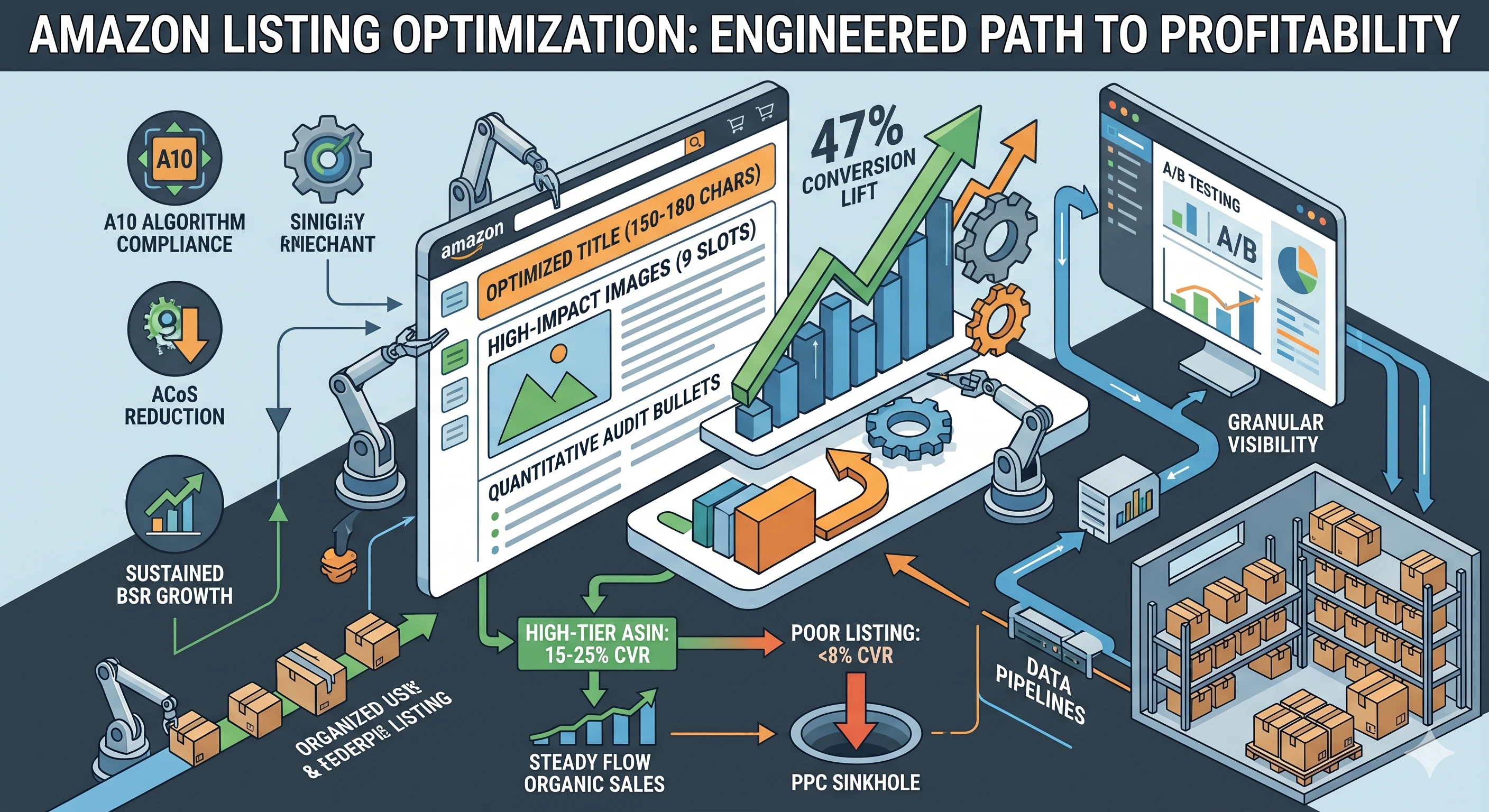
In the competitive Amazon landscape of 2026, listing optimization is no longer a creative exercise but a rigorous engineered path to profitability. The performance gap between a high-tier listing and a mediocre one is stark: top-performing ASINs consistently achieve conversion rates (CVR) of 15-25%, fueling organic ranking and lowering ACoS. In contrast, poorly structured listings—often converting at less than 8%—act as a sinkhole for PPC spend, failing to gain traction despite aggressive bidding.
This guide serves as a comprehensive blueprint for mastering the A10 algorithm. We will detail a systematic optimization strategy covering advanced keyword research, title structures targeting 150-180 characters, and high-impact image strategies that utilize every available slot. By moving from subjective adjustments to a quantitative audit of your digital assets, sellers can unlock significant growth; case studies demonstrate that precise listing refinements can yield a 47% conversion lift.
To ensure these improvements translate into sustained BSR growth, data-driven validation is essential. While Amazon’s "Manage Your Experiments" provides basic insights, DeepBI’s A/B Testing feature tracks listing experiment results beyond what Amazon's native tools show, offering the granular visibility needed to refine every element of the customer journey.
2. Understanding Amazon's A10 Algorithm
The A10 algorithm serves as the primary arbiter of product visibility, determining the precise order of search results and directly influencing a product's BSR. At its core, A10 is designed to reward listings that demonstrate high conversion performance and sustained sales velocity. To succeed, sellers must follow an engineered path that prioritizes the algorithm's specific weighting breakdown: 35-40% for sales velocity, 25-30% for keyword relevance, and 20-25% for customer satisfaction metrics. By focusing on these pillars, a listing can maintain a competitive CVR and secure top-tier placement within the marketplace.
2.1. Pro Tip: A10 vs A9 Changes in 2026
The evolution from A9 to A10 represents a strategic shift in how Amazon evaluates traffic. A critical change is the reduced weighting of external traffic; off-Amazon PPC now contributes significantly less to organic ranking than it did previously. Instead, A10 places a premium on native Amazon traffic and the "trust funnel." There is an increased emphasis on customer satisfaction metrics, such as review quality, return rates, and seller feedback. A quantitative audit of these factors is vital, as high return rates can negate gains in sales velocity. Systematic optimization now requires a focus on converting internal searchers into loyal customers to ensure long-term ranking stability.
3. Step 1: Keyword Research for High-Converting Terms
Keyword stuffing is a legacy tactic that now triggers algorithmic penalties, leading to poor CVR and inflated ACoS. Modern A10 optimization requires a systematic optimization approach that balances search volume with buyer intent. By targeting 3-5 primary and 10-15 secondary keywords, sellers can improve relevance and stabilize their BSR through high-quality traffic.
3.1. Keyword Research Methodology
Effective research begins with a quantitative audit of the niche. Utilize reverse ASIN lookups and Amazon autocomplete mining to identify high-performing terms. Filter these results by monthly search volume: prioritize terms with 3,000+ searches for main categories and 500+ for long-tail opportunities. Beyond volume, assess buyer intent—specific phrases like "non-slip yoga mat" often convert better than generic terms like "yoga." Finally, perform a competition analysis by checking the top 10 search results; if leaders hold 4.5+ stars and 5,000+ reviews, your keyword strategy must be hyper-relevant to compete.
3.2. Keyword Targeting Framework
Implementing an engineered path for keyword placement ensures maximum visibility and conversion.
- Primary Keywords (10K+ volume): Limit to 3-5 high-relevance terms. These must be integrated into the title and bullet points to maximize CTR.
- Secondary Keywords (1K-10K volume): Select 10-15 terms for use in bullet points, product descriptions, and backend search terms.
- Long-tail Keywords: These low-volume, high-conversion terms should be placed exclusively in the backend search terms to capture specific buyer queries without diluting the primary sales copy.
This structured distribution ensures the A10 algorithm correctly indexes the listing while maintaining a natural reading flow for the customer.
4. Step 2: Title Optimization Formula
The product title is the most critical factor for both keyword indexing and click-through rate (CTR). An effective title follows an engineered path that satisfies the A10 algorithm’s demand for relevance while providing the clarity human buyers need to click. To maximize visibility without triggering suppression, maintain an optimal length of 150–180 characters.
4.1. Winning Title Formula
A high-converting title requires a systematic optimization of its structure to ensure the most important data appears "above the fold" on mobile devices. Use the following formula:
[Brand] + [Primary Keyword] + [Key Feature] + [Use Case] + [Size/Specs]
Example: KitchenMaster Stainless Steel Mixing Bowls - Non-Slip Silicone Base for Baking and Meal Prep - Set of 5.
In this example, the brand establishes authority, the primary keyword ensures immediate indexing, and the "Non-Slip" feature addresses a specific consumer pain point. This structure directly impacts BSR by aligning the listing with high-intent search queries while providing the technical specifications necessary to maintain a high CVR.
4.2. Title Optimization Mistakes to Avoid
Errors in title construction often lead to increased ACoS and wasted ad spend. Conduct a quantitative audit of your listings to ensure you are not committing these common violations:
- ALL CAPS: Using all capital letters is a TOS violation that risks search suppression.
- Promotional Language: Terms like "Best," "Top Rated," or "Sale" are prohibited and reduce professional credibility.
- Keyword Stuffing: Overloading the title with repetitive terms destroys readability and lowers CTR.
- Irrelevant Keywords: Including unrelated terms to "cast a wider net" actually dilutes your relevance score and harms organic ranking.
5. Step 3: Bullet Points That Sell (Features → Benefits)
Bullet points are the primary engine for CVR optimization. While the title captures the initial click (CTR), the bullets close the deal by transforming technical specifications into an engineered path toward a purchase decision. To maximize BSR and reduce the listing cycle time, sellers must move beyond dry descriptions and adopt a systematic optimization approach that prioritizes tangible customer outcomes over raw data.
5.1. Bullet Point Formula (5 bullets)
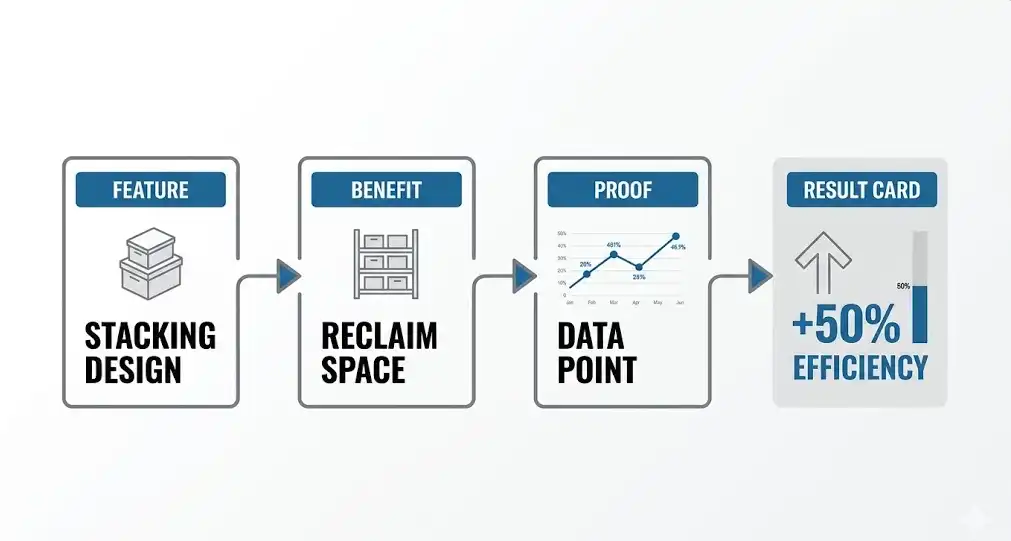
Each bullet must follow a rigid "Feature → Benefit → Proof" structure. Start with a benefit-focused headline in ALL CAPS to grab attention, then explain the feature with natural keyword integration and specific data to build credibility. Using the KitchenMaster Stainless Steel Mixing Bowls as a model, apply this formula:
- MAXIMIZE CABINET SPACE: Our nesting design allows all 5 bowls to stack perfectly, reclaiming 50% of your storage area compared to traditional non-stacking sets.
- ELIMINATE KITCHEN MESS: The non-slip silicone base ensures 100% stability during high-speed mixing, preventing spills on your countertops even when whisking heavy batters.
- EXTEND FOOD FRESHNESS: BPA-free airtight lids create a secure seal that keeps prep work fresh for up to 72 hours, significantly reducing food waste.
- EFFORTLESS MEASURING: Laser-etched interior markings provide instant volume checks for both metric and imperial units, ensuring 100% recipe accuracy without needing extra tools.
- LIFETIME RUST-FREE USE: Constructed from premium 304 stainless steel, these bowls are engineered to withstand 1,000+ dishwasher cycles without any signs of corrosion.
6. Step 4: Images That Convert at 20%+ Rates
Visual assets are the primary driver of conversion on Amazon, influencing 65-70% of the final purchase decision. To achieve a CVR exceeding 20%, sellers must move beyond basic photography toward a systematic optimization of the entire visual stack.
6.1. Optimal Image Sequence (9 slots)
Amazon allows up to nine image slots; utilizing every one is essential for reducing ACoS and improving BSR. The sequence should follow this logic:
- Main Image: Pure white background, TOS compliant, 85%+ frame fill, and 2000x2000px minimum for high-resolution zoom.
- Lifestyle: The product shown in a realistic use-case scenario.
- Feature Callout 1: Highlighting a primary USP with clear text overlay.
- Feature Callout 2: Highlighting a secondary functional benefit.
- Size/Scale: A demonstration of dimensions to manage customer expectations.
- Unboxing: A comprehensive view of all included contents.
- Angles: Multiple perspectives or available color variations.
- Comparison: Your product versus generic competitors using neutral labels.
- Trust Signals: Displaying certifications, guarantees, or testimonials.
6.2. Image Optimization Best Practices
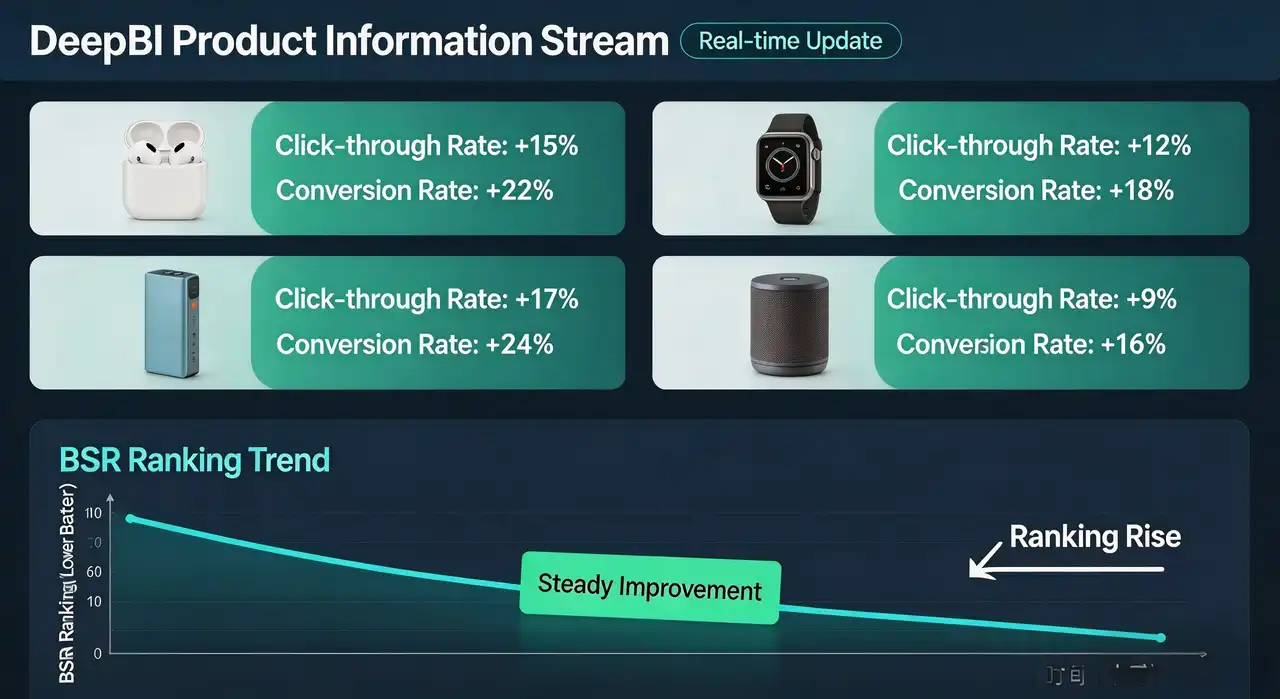
High-converting listings follow an engineered path of visual communication. Invest $300-500 in professional photography to ensure technical precision. For mobile users, infographic text must maintain a 60-80pt font minimum to ensure readability. Branding should remain consistent across all assets to build authority. Sellers should perform a quantitative audit of their visual performance using Amazon's Manage Your Experiments. Furthermore, track listing performance over time with DeepBI's Products Feed to see which optimization changes drive results in CTR and CVR.
7. Step 5: A+ Content (Enhanced Brand Content)
For brand-registered sellers, A+ Content is a critical component of a systematic optimization strategy. While it does not directly index for keywords like the title or backend terms, Amazon’s internal data confirms its impact: it typically drives a 3–10% increase in conversion rates (CVR) and a 5–8% lift in traffic. By reducing buyer hesitation through visual storytelling and technical clarity, A+ Content accelerates sales velocity. This momentum directly influences the A10 algorithm, leading to an indirect but significant boost in Best Seller Rank (BSR) and organic search visibility.
7.1. Effective A+ Content Structure
To maximize the ROI of your brand assets, follow an engineered path for content layout. A high-performing A+ page should include:
- Brand Story Header: A high-resolution logo paired with a concise mission statement to establish immediate authority.
- Key Features: A 3–4 column module using icons and brief descriptions to highlight unique selling points.
- Detailed Specifications: A clear breakdown of dimensions and technical specs to minimize post-purchase dissatisfaction.
- Use Case Scenarios: Lifestyle imagery demonstrating the product in real-world environments.
- Comparison Chart: A module comparing the current product against others in your catalog to cross-sell or prevent customers from leaving your brand ecosystem.
Implementing this structure ensures a quantitative audit of your brand presence meets Amazon's premium standards, effectively lowering ACoS by converting more visitors into buyers.
8. Step 6: Backend Search Terms (The Hidden Ranking Boost)
Backend search terms represent a critical, invisible layer of the A10 algorithm's indexing process. While front-end copy focuses on conversion and readability, the backend is reserved for pure data retrieval. By utilizing this space, sellers can capture high-intent, long-tail traffic without cluttering the customer-facing interface. This systematic optimization ensures that the listing remains aesthetically clean while maximizing its reach across diverse search queries, ultimately supporting a healthier BSR.
8.1. Backend Keyword Strategy
To maximize the impact on CVR and organic ranking, sellers must adhere to a strict 249-byte limit. Exceeding this threshold causes Amazon to ignore the entire field, leading to a total loss of potential indexing. The engineered path to success involves a quantitative audit of existing front-end keywords to ensure zero redundancy. If a keyword appears in the title or bullet points, repeating it in the backend provides no additional ranking benefit and wastes valuable byte space.
Instead, focus on high-value synonyms—for instance, if "mixing bowl" is in the title, use "prep bowl" or "baking basin" in the backend. Include common misspellings and industry-standard abbreviations that customers frequently use to capture "fat-finger" search traffic. Amazon’s indexing logic ignores punctuation, so use single spaces to separate terms rather than commas. Crucially, avoid competitor brand names to prevent listing suppression or policy violations. This precision-driven approach directly lowers ACoS by capturing relevant traffic that competitors often overlook.
9. Step 7: Review Optimization (Quantity + Quality)
Reviews serve as a critical dual-force ranking signal and conversion catalyst within the A10 algorithm. A quantitative audit of top-performing listings shows that those with 100+ reviews typically achieve a CVR 2-3x higher than those with under 20 reviews. Since 89% of shoppers consult feedback before purchasing, maintaining a 4+ star rating is the minimum threshold required to sustain a competitive BSR and ensure long-term visibility.
9.1. Ethical Review Acceleration Strategies
Sellers must implement a systematic optimization of review acquisition to build social proof safely. Enroll new products in Amazon Vine to generate 15-30 initial reviews from trusted voices. Utilize the "Request a Review" button in Seller Central between 4 and 14 days post-delivery to trigger automated, compliant follow-ups. Product inserts should feature QR codes directing customers to a "Contact Us" or support page rather than soliciting reviews directly. Additionally, responding to negative reviews professionally can mitigate damage to the listing's reputation and conversion potential.
9.2. Never Do These (TOS Violations)
To avoid account suppression or permanent de-indexing, sellers must strictly adhere to Amazon’s Terms of Service. Prohibited practices include offering incentives such as gift cards or discounts in exchange for feedback. Engaging in review swaps with other sellers or paying third-party services for reviews are high-risk violations that trigger fraud detection. Furthermore, reviews from family or friends are strictly forbidden, as they compromise marketplace integrity and can lead to immediate listing suspension.
10. Step 8: A/B Testing Your Listing Scientifically
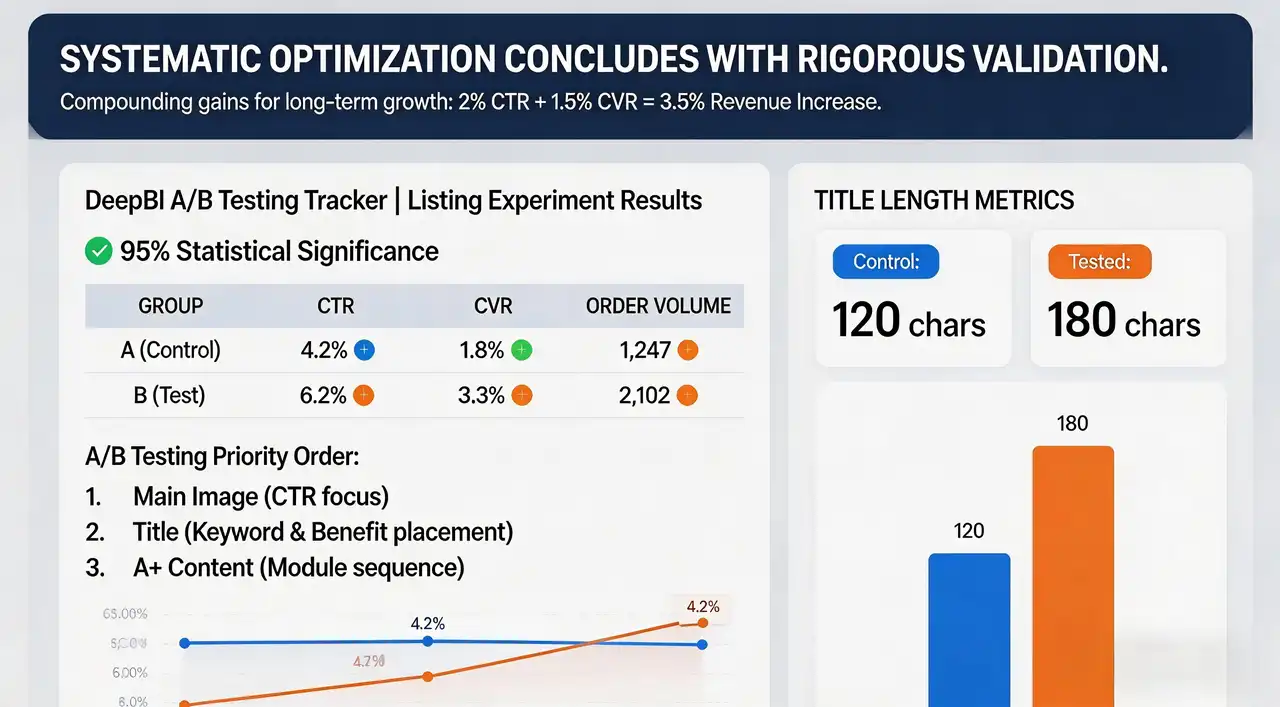
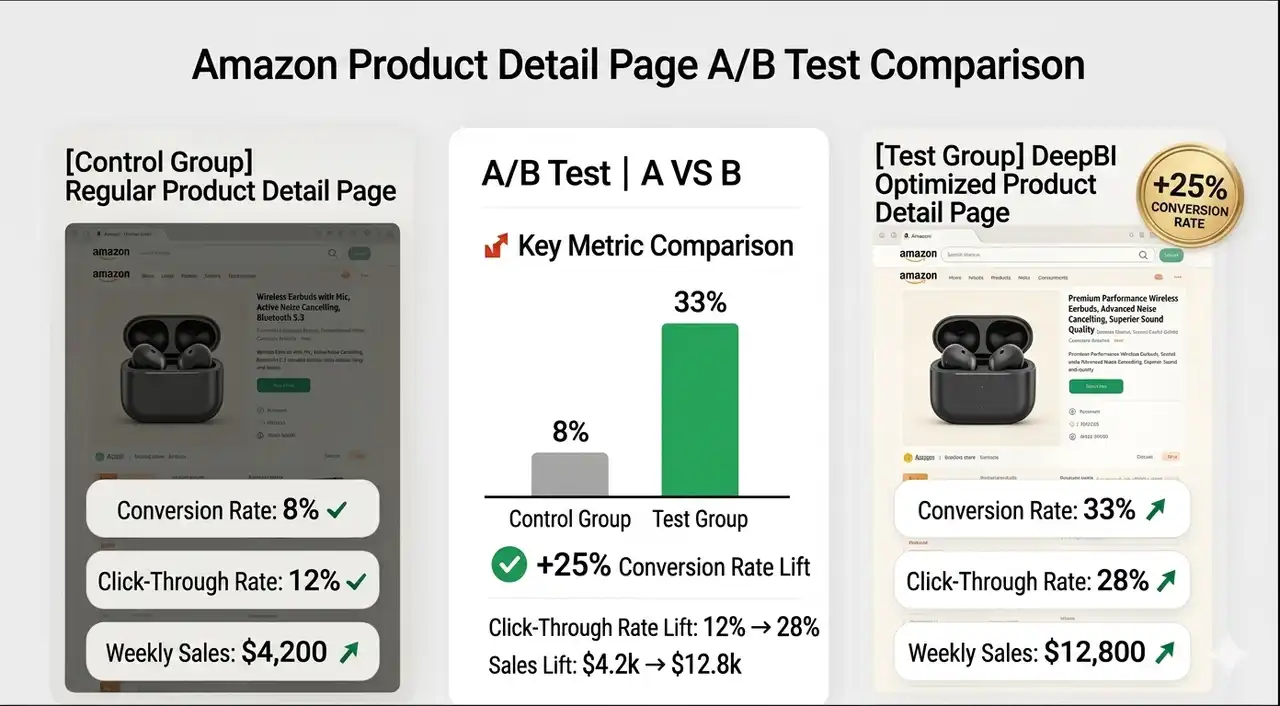
Systematic optimization concludes with rigorous validation. Relying on intuition often leads to stagnant BSR and inflated ACoS. By utilizing Amazon’s "Manage Your Experiments" tool alongside the DeepBI A/B Testing Tracker, sellers can execute a quantitative audit of every listing element. This engineered path ensures that every modification is backed by statistical significance rather than guesswork.
The power of A/B testing lies in compounding gains. For instance, a 2% improvement in CTR from a main image combined with a 1.5% lift in CVR from a refined title results in a 3.5% total revenue increase. These incremental wins are the foundation of long-term growth, providing insights that standard Amazon tools often overlook.
10.1. A/B Testing Priority Order
To maximize ROI, testing must follow a strict hierarchy based on conversion impact. The main image is the highest priority, as it dictates the initial CTR; sellers should test lifestyle versus white backgrounds, scale, or different product angles. The title follows, focusing on benefit-driven versus feature-heavy copy and keyword placement. Finally, A+ Content should be optimized by testing module sequences, copy length, and comparison charts.
For valid results, isolate one variable at a time and run tests for a minimum of 4-6 weeks or until reaching a 95% confidence level. This disciplined approach ensures that performance shifts are accurately attributed to specific changes, facilitating continuous, systematic optimization.
11. Real Optimization Case Study: 47% Conversion Increase
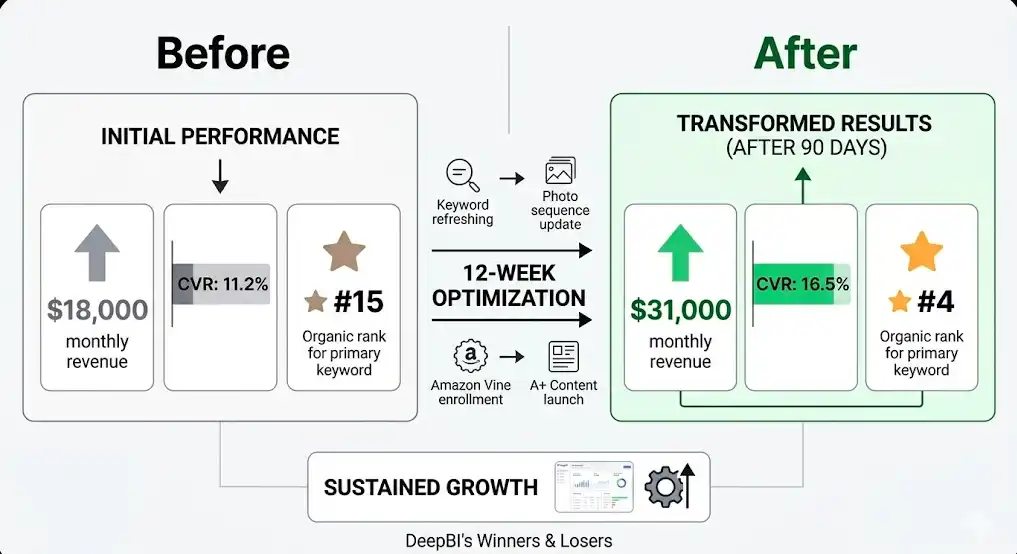
To illustrate the power of an engineered path to growth, consider a kitchen gadget seller who transitioned from stagnant performance to category leadership. Initially, the brand generated $18,000 in monthly revenue with a CVR of 11.2%, a 4.3-star rating, and a #15 organic rank for their primary keyword.
Through a quantitative audit, the seller identified critical gaps in visual storytelling and keyword indexing. Over a 12-week period of systematic optimization, the team executed a complete overhaul: refreshing keyword targets, deploying professional photography with a strategic image sequence, enrolling in Amazon Vine to boost social proof, and launching high-impact A+ Content.
The results after 90 days were transformative. The listing’s CVR surged to 16.5%—a 47% increase—while the star rating improved to 4.6 with 134 reviews. This conversion lift propelled the organic rank from #15 to #4, driving a 72% increase in organic sales and pushing monthly revenue to $31,000. To sustain this momentum, the seller utilized DeepBI's Winners & Losers feature, which helps identify which optimized listings are driving the most profit, allowing the team to prioritize future optimization efforts effectively based on real-time performance data.
12. Complete Listing Optimization Checklist
To maintain a high BSR and minimize ACoS, sellers must follow an engineered path to listing perfection. This systematic optimization ensures no technical or creative element is neglected, directly impacting organic ranking and CVR.
- Keyword Research: Identify and categorize primary, secondary, and long-tail keywords.
- Title Optimization: Craft a 150-180 character title with front-loaded primary keywords for maximum CTR.
- Bullet Points: Complete all 5 slots using a feature-to-benefit structure with integrated keywords.
- Product Description: Ensure a keyword-rich, persuasive narrative to drive conversion.
- Backend Search Terms: Utilize the full 249-byte limit with synonyms and no duplicates.
- Visual Assets: Populate all 9 image slots with TOS-compliant main images, lifestyle shots, infographics, scale, and comparison images.
- A+ Content: Deploy enhanced brand content to improve CVR and brand authority.
- Vine Enrollment: Secure early reviews for new listings to build social proof.
- Review Automation: Enable automated requests to maintain a healthy feedback loop.
- A/B Testing: Establish a testing schedule for main images, titles, and A+ Content.
12.1. Optimize Listings with Data-Driven Insights
Effective scaling requires more than intuition; it demands a quantitative audit of current performance. Use DeepBI's analytics to identify which listings need optimization and track performance improvements over time. By monitoring shifts in CTR and ACoS through centralized data, sellers can refine their strategy to ensure every listing update contributes to long-term growth and improved BSR.
13. Making Optimization a Continuous Habit
To achieve sustainable growth, sellers must treat listing optimization as a perpetual improvement system rather than a one-time project. This requires a disciplined cadence: respond to market shifts weekly, execute A/B testing monthly, and perform a full quantitative audit quarterly. Utilizing product feed monitoring tools is essential to track ranking and conversion trends systematically, ensuring every adjustment is driven by data rather than intuition.
Implement this engineered path by starting with your highest-revenue SKU to maximize immediate impact. Follow a rigorous execution sequence:
- Keyword Audit: Re-align with current A10 search intent and indexing patterns.
- Title & Bullet Refresh: Optimize for CTR and mobile-first readability.
- Visual Upgrade: Enhance main images and A+ Content to drive CVR.
- A/B Testing: Use Manage Your Experiments to validate changes against live traffic.
Once the primary SKU is optimized, move systematically to the next. This systematic optimization separates sustainable growth from random acts of marketing. Within 6 to 12 months, this approach creates a catalog that compounds organic sales and improves BSR without increasing PPC spend. By consistently refining the listing, sellers stabilize their ACoS and secure a long-term competitive advantage in the 2026 Amazon marketplace.
14. Sources & References
The methodologies presented throughout this guide—specifically those designed to maximize CTR and stabilize ACoS—are derived from a synthesis of official platform guidelines and authoritative consumer behavior studies. To achieve a sustainable BSR and minimize listing cycle time, sellers should treat these references as the technical baseline for any systematic optimization effort. The following resources provide the foundational logic for the engineered path required to convert high-intent traffic into verified sales in the 2026 landscape.
- Copyblogger: How to Create Product Pages – Expert insights into high-conversion copywriting and the persuasive structures that drive buyer intent.
- Nielsen Norman Group: How People Read Online – Critical data on eye-tracking and information scanning patterns that dictate effective mobile-first layout strategies.
- Amazon: A+ Content Design Guide – Official technical specifications and best practices for visual storytelling and Brand Registry module utilization.
- Amazon: Keyword Research Guide – The primary framework for understanding indexing logic, semantic relevance, and search query performance within the A10 environment.
- BrightLocal: Consumer Review Survey 2025 – The latest industry benchmarks regarding social proof, review velocity, and their direct correlation with CVR and brand trust.
15. Continue Learning
Mastering the A10 algorithm through listing optimization is a critical step, but long-term success on Amazon requires a multi-dimensional approach. To truly scale in the 2026 marketplace, sellers must move beyond content and adopt an engineered path that synchronizes listing performance with financial and operational health. While high CVR and a strong BSR are essential, they are unsustainable if profit margins are eroded by inefficient pricing or if stockouts disrupt sales velocity and increase ACoS.
A quantitative audit of your entire business model—not just your keywords—is essential for systematic optimization. Effective pricing strategies directly influence your CTR and conversion rates, while precise inventory control ensures your listing cycle time remains efficient by avoiding the high costs of emergency restocking or long-term storage fees. To deepen your expertise in these interconnected domains and ensure your growth is both profitable and sustainable, we recommend exploring the following strategic resources:
- Amazon Pricing Strategy: How to Set and Test Prices for Maximum Profit (2026): Discover how to balance competitive positioning with margin protection to maximize total yield.
- Amazon FBA Profit Margins by Category (2026 Benchmarks): Compare your performance against updated industry standards to identify specific areas for cost reduction.
- Amazon Inventory Management 2026: Cash Flow Strategies: Master the logistics of maintaining high stock availability to protect your organic ranking and financial liquidity.