

Introduction
Amazon’s marketplace has evolved into a global commerce powerhouse, attracting over 2 billion monthly visits and generating more than $500 billion in annual sales. While these figures represent a massive opportunity for brands, they also signal an environment of intense competition where visibility is no longer guaranteed. For sellers, the difference between a high-performing product and one that languishes in search results often comes down to the precision of their listing data.
Success in this landscape requires more than just high-quality products; it demands deliberate data management across titles, bullet points, descriptions, and backend search terms. Without a systematic optimization approach, sellers often fall into a cycle of blind trial and error, making adjustments based on intuition rather than evidence. This lack of clarity directly impacts critical performance metrics, leading to stagnant Click-Through Rates (CTR), poor Conversion Rates (CVR), and a declining Best Sellers Rank (BSR).
To break this cycle, brands must transition from treating listing management as a creative task to treating it as a rigorous, data-driven discipline. By utilizing a quantitative audit of existing assets, tools like DeepBI allow sellers to identify specific gaps in their content and categorization. This shift from "art" to "science" provides an engineered path to growth, streamlining the listing cycle time and ensuring that every modification is backed by market data. The following strategies outline how to leverage these insights to maximize visibility and drive sustainable sales revenue on Amazon.
Amazon Listing Optimization Best Practices
The Amazon A10 algorithm serves as the fundamental logic governing product visibility and sales velocity. Unlike previous iterations, A10 prioritizes listings that demonstrate high relevancy and organic authority, primarily measured through Click-Through Rate (CTR) and Conversion Rate (CVR). For marketplace managers, understanding this mechanism is not merely a technical requirement but a strategic necessity to avoid the pitfalls of subjective aesthetic modifications that often lead to inconsistent performance.
A quantitative audit of listing performance typically reveals two critical friction points: the traffic funnel and the trust funnel. When a listing’s CTR falls below the 0.35% threshold, it indicates a failure to capture attention within the search results, necessitating an immediate optimization of the main image and title relevancy. Conversely, a CVR below 7% suggests a breakdown in the trust funnel, where the product description, bullet points, or secondary imagery fail to convert browsers into buyers. By identifying these specific gaps, sellers can move away from guesswork and follow an engineered path toward ranking recovery.
Effective optimization requires a systematic optimization of all digital assets. Tailoring product titles and descriptions to align with high-intent keywords directly impacts search rankings and recommendation placement. Furthermore, maintaining high-quality, quality-controlled product data across global storefronts—leveraging localized environment simulations for over 20 countries—builds the brand trust necessary to improve Best Sellers Rank (BSR). This data-driven approach ensures that every modification contributes to a reduction in ACoS and a shorter listing cycle time, transforming raw product information into a high-performing commercial asset.
Conduct keyword research.
Strategic keyword research serves as the foundation of an engineered path toward marketplace visibility. In the competitive Amazon landscape, listing optimization has evolved beyond simple copywriting; it requires converting deep market insights into precise, data-driven instructions. Traditional methods often suffer from "survivor bias" or rely on subjective experience, leading to a "non-quantified" gap where the chosen keywords fail to align with actual customer intent. This misalignment directly suppresses the Click-Through Rate (CTR) and Conversion Rate (CVR), as the product remains invisible to its primary target audience.
To bridge this gap, sellers must first conduct a quantitative audit of their target audience, defining specific needs, pain points, and preferences. A primary source of real-time data is Amazon’s own search bar, where autocomplete suggestions reveal the exact phrases customers use during their journey. However, to achieve a truly systematic optimization, marketplace managers should leverage specialized tools such as Helium 10, Jungle Scout, or Sonar. These tools allow for a granular analysis of search volume and the identification of high-performing phrases that competitors are successfully ranking for.
A sophisticated strategy prioritizes long-tail keywords over broad, highly competitive terms. While long-tail phrases may have lower individual search volumes, they often result in a significantly higher CVR and a more efficient ACoS because they capture shoppers with specific, high-intent purchase goals. Beyond the visible product title and bullet points, sellers must also optimize the backend search terms. Utilizing the full 250-character limit in the backend ensures that the algorithm indexes the product for a wider range of relevant queries without cluttering the customer-facing interface.
Ultimately, keyword research must be treated as an ongoing operational cycle rather than a one-time task. As consumer behavior shifts and new competitors emerge, continuous monitoring and adjustment of the keyword strategy are essential to maintain a high Best Sellers Rank (BSR) and ensure long-term growth. By moving away from "ambiguous" human intuition and toward a data-centric approach, sellers can ensure their listings are consistently positioned to capture qualified traffic.
Optimize your product title.
The product title serves as the most critical bridge between search intent and conversion. It is the primary data point for Amazon’s indexing algorithm and the first element a customer evaluates. A high-performing title must follow an engineered path that balances technical SEO requirements with human readability to maximize Click-Through Rate (CTR) and ultimately improve the Best Sellers Rank (BSR).
To achieve systematic optimization, titles should generally remain under 150 characters. Each word’s first letter must be capitalized, while promotional phrases should be strictly avoided to maintain professional credibility and prevent listing suppression. The structure must be logical and data-backed, typically following a sequence of Brand Name, Product Type, Key Features, and essential specifications such as size, quantity, or color.
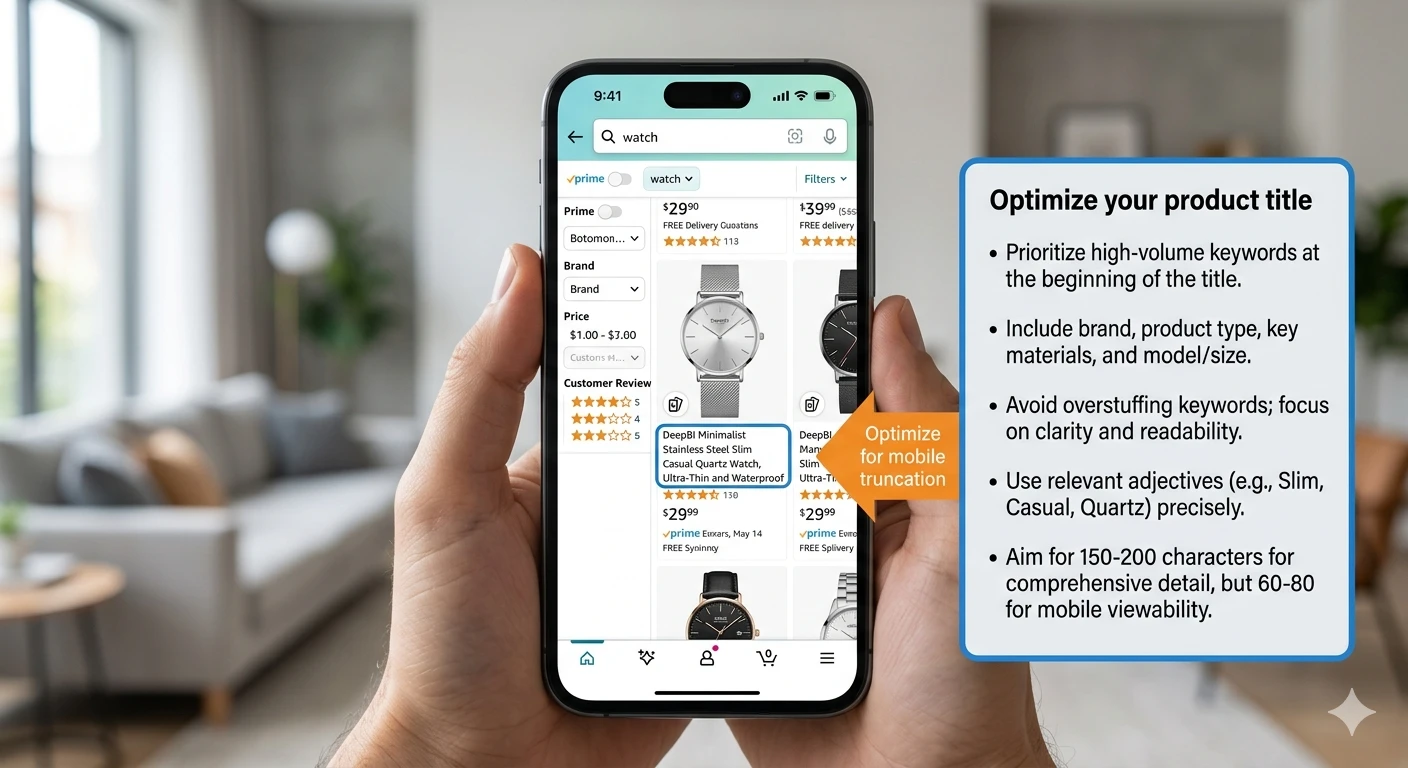
Strategic keyword placement is paramount. Placing the most relevant and high-volume keywords at the beginning of the title ensures they are indexed with higher weight. This is particularly vital for mobile shoppers, where the interface often truncates titles after the first 80 characters. By front-loading value propositions and standout features, sellers can capture attention in the split second a user scrolls through search results, directly impacting the listing's initial engagement metrics.
Modern listing management requires more than just manual intuition; it demands a quantitative audit of the competitive landscape. By utilizing Large Language Models (LLM) to perform reverse decomposition of top-performing competitor titles and descriptions, sellers can identify the exact semantic markers that drive ranking. This data-driven approach ensures that the title is not just a string of keywords, but a high-conversion asset that reduces ACoS by capturing more qualified organic traffic. When the title aligns perfectly with search queries and user expectations, the resulting increase in CTR and CVR creates a positive feedback loop, accelerating the listing cycle time and solidifying market position.
Optimize your product description.
In the current Amazon landscape, where rising traffic costs exert pressure on margins, the product description serves as the final gatekeeper for conversion. Moving beyond a mere list of technical specifications is essential; the description must transition into a persuasive narrative that bridges the gap between a customer’s problem and your product’s solution. This systematic optimization ensures that every sentence contributes to a higher CVR and a lower ACoS.
Effective descriptions leverage benefit-driven storytelling to communicate value. Instead of simply stating a product's dimensions or materials, sellers should emphasize how these features solve specific pain points. By integrating emotional triggers—such as the convenience of a time-saving tool or the trust established through a clear brand story—sellers can differentiate their offerings from generic competitors. This approach transforms the description from a passive information block into an engineered path toward the "Add to Cart" button.
To achieve this level of precision, a quantitative audit of the competitive landscape is necessary. Utilizing DeepBI’s multi-dimensional semantic benchmarking allows sellers to identify the exact terminology and value propositions that resonate within their specific category node. By aligning the description with data-driven evidence chains rather than subjective intuition, sellers can eliminate the "blind trial and error" phase that often plagues new launches. This alignment not only improves the listing’s relevance for Amazon’s algorithm but also shortens the listing cycle time by providing a clear blueprint for content creation.
Structure is equally critical for scannability. Shoppers, particularly on mobile devices, favor short sentences and concise paragraphs. Sellers should proactively answer potential customer questions within the text, reducing the friction that leads to bounce rates. For those with Brand Registry, A+ Content is a non-negotiable tool to visually reinforce these benefits and build long-term brand equity. When primary and secondary keywords are integrated seamlessly—without resorting to jargon—the result is a listing that maintains high organic visibility and BSR while maximizing the efficiency of every paid click.
Optimize product key features (bullet points).
Product bullet points serve as the primary vehicle for rapid information processing, acting as the critical bridge between a customer’s initial click and the final conversion. When bullet points are cluttered or fail to address immediate concerns, the result is a direct drop in Conversion Rate (CVR) and an inflated ACoS due to wasted ad spend on non-converting traffic. To prevent these business losses, sellers must treat bullet points as a high-velocity communication tool rather than a mere technical specification list.

Effective optimization follows an engineered path where the most compelling and unique selling propositions are positioned at the very top. Customers typically scan the first two points to decide if a product warrants further investigation. To facilitate this quick assessment, each point should begin with capitalized keywords that summarize the benefit, followed by short, punchy sentences. A concise structure of 3–5 bullet points is ideal; exceeding this often leads to information fatigue, which negatively impacts the mobile shopping experience and listing performance.
A quantitative audit of competitor landscapes and customer feedback is essential to ensure these points resonate with market demand. By utilizing DeepBI to automate the mining of competitor pain points and cross-validating business data, brands can identify exactly which features drive purchase intent. This data-driven approach moves beyond subjective guessing, allowing for systematic optimization that highlights verified advantages.
However, speed and automation must not compromise listing integrity. The optimization process must strictly adhere to the physical reality of the product. AI-driven assessments are prohibited from fabricating parameters or inventing defects that are not visible in the actual product images. All diagnostic improvements must be grounded in "visible attributes" and "confirmed specifications," ensuring that the material, color, and industrial design described in the text match the customer's eventual experience.
Finally, listing optimization is not a one-time task. Sellers must continuously monitor performance metrics and adjust bullet points based on evolving customer feedback and shifting market trends. By maintaining this rigorous alignment between data-backed highlights and factual product attributes, brands can significantly improve their BSR and maintain a competitive edge in the marketplace.
Use high-quality product images.
In the Amazon marketplace, visual assets are the most influential factor in determining Click-Through Rate (CTR) and Conversion Rate (CVR). Because customers cannot physically interact with a product, high-quality imagery serves as the primary vehicle for building brand trust and facilitating the purchase decision. Failure to meet visual standards directly results in higher ACoS and a lower Best Sellers Rank (BSR).
To maintain a competitive edge, sellers must adhere to Amazon’s strict technical requirements while pursuing visual excellence. The main image must feature a pure white background with the product occupying at least 85% of the frame. High-resolution files—ideally 1000x1000 pixels or higher—are essential to enable the zoom function, which is a critical driver for both mobile and desktop conversions.
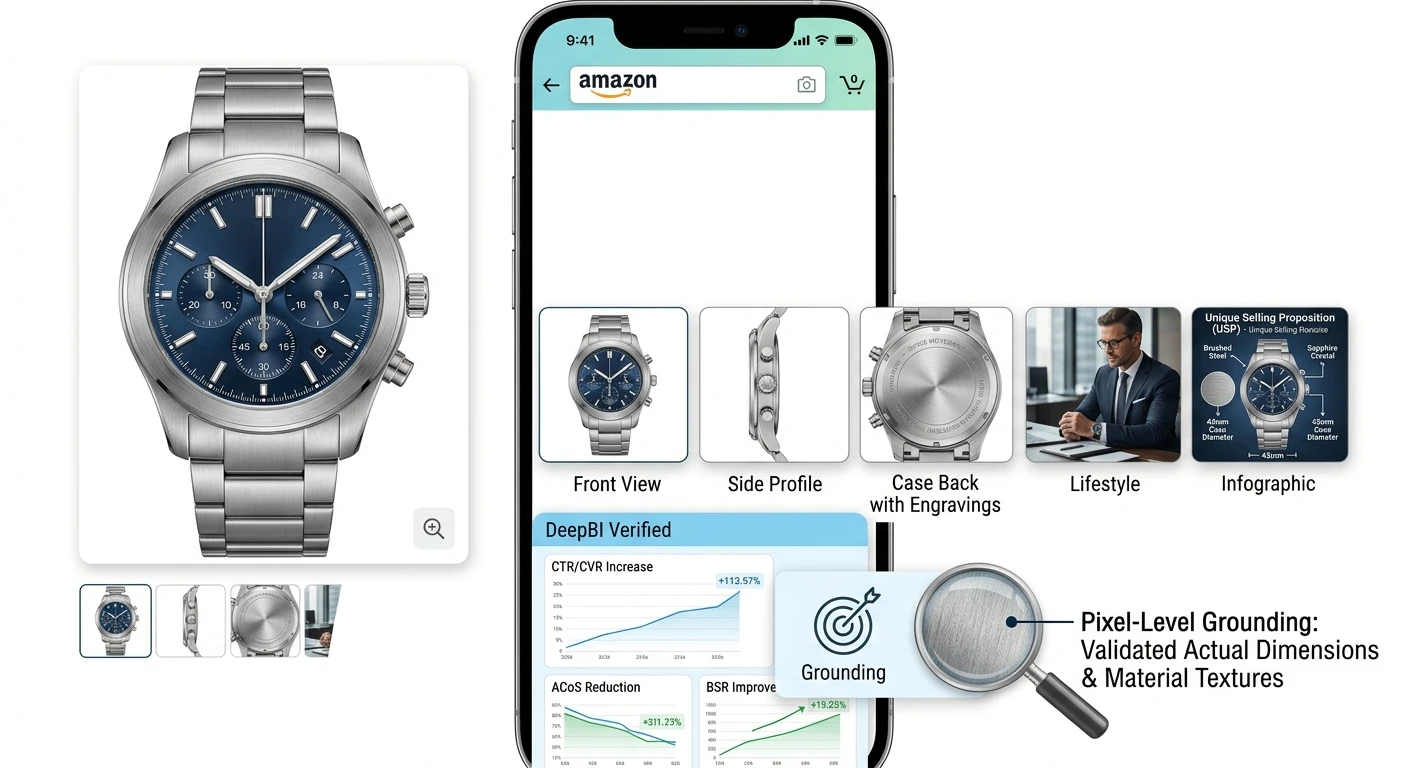
Beyond the main image, a comprehensive visual strategy requires an engineered path that includes multiple perspectives—front, side, back, and close-ups—to eliminate buyer uncertainty. DeepBI facilitates this through a quantitative audit of a listing’s visual performance, scoring images against top-performing competitors. By utilizing "product DNA" mapping and pixel-level reasoning, the system ensures that any AI-enhanced visuals remain strictly grounded in the product's actual physical parameters, such as dimensions and material textures, preventing the "hallucination" of non-existent features that could lead to negative reviews and high return rates.
A systematic optimization of the image stack should also incorporate lifestyle imagery and infographics. Lifestyle shots place the product in a relatable context, while infographics highlight unique selling points and technical specifications that text alone might fail to convey. By integrating these assets through a flexible replacement mechanism, sellers can dynamically adjust their visual presentation based on real-time market feedback, ultimately shortening the listing cycle time and maximizing organic visibility.
Optimize the product price.
Pricing is not a static figure but a dynamic lever that directly dictates a product's Best Seller Rank (BSR) and Advertising Cost of Sales (ACoS). In an era of intensifying marketplace competition, sellers often face the dual pressure of rising traffic costs and fluctuating Conversion Rates (CVR). To navigate this, a quantitative audit of the pricing structure is essential to ensure that every price adjustment is backed by market logic rather than intuition.
Effective pricing requires a delicate equilibrium between internal costs, market demand, and the perceived value of the listing. By analyzing competitor pricing history through tools like Keepa or Helium 10, sellers can identify price corridors that trigger high Click-Through Rates (CTR) without eroding profit margins. However, manual monitoring is insufficient for high-velocity categories. This is where an engineered path to pricing becomes critical. DeepBI’s diagnostic agents analyze real-time market shifts, allowing sellers to move beyond vague suggestions toward data-backed adjustments.
Leveraging DeepBI’s integration with Amazon’s SP-API, sellers can implement a systematic optimization of their pricing strategy. This includes the strategic use of psychological pricing techniques and the deployment of Amazon’s Automated Pricing tool to maintain the Buy Box. Furthermore, tactical promotions such as Coupons and Lightning Deals should be synchronized with inventory levels and BSR targets. When a listing suffers from low CVR despite high traffic, DeepBI’s analysis can pinpoint whether the price-to-value perception is lagging behind competitors, enabling precise instructions for price correction or promotional intervention. By aligning dynamic pricing with real-time performance data, sellers can protect their margins while maintaining the competitive edge necessary to drive long-term growth.
Categorize your products effectively and provide additional attributes.
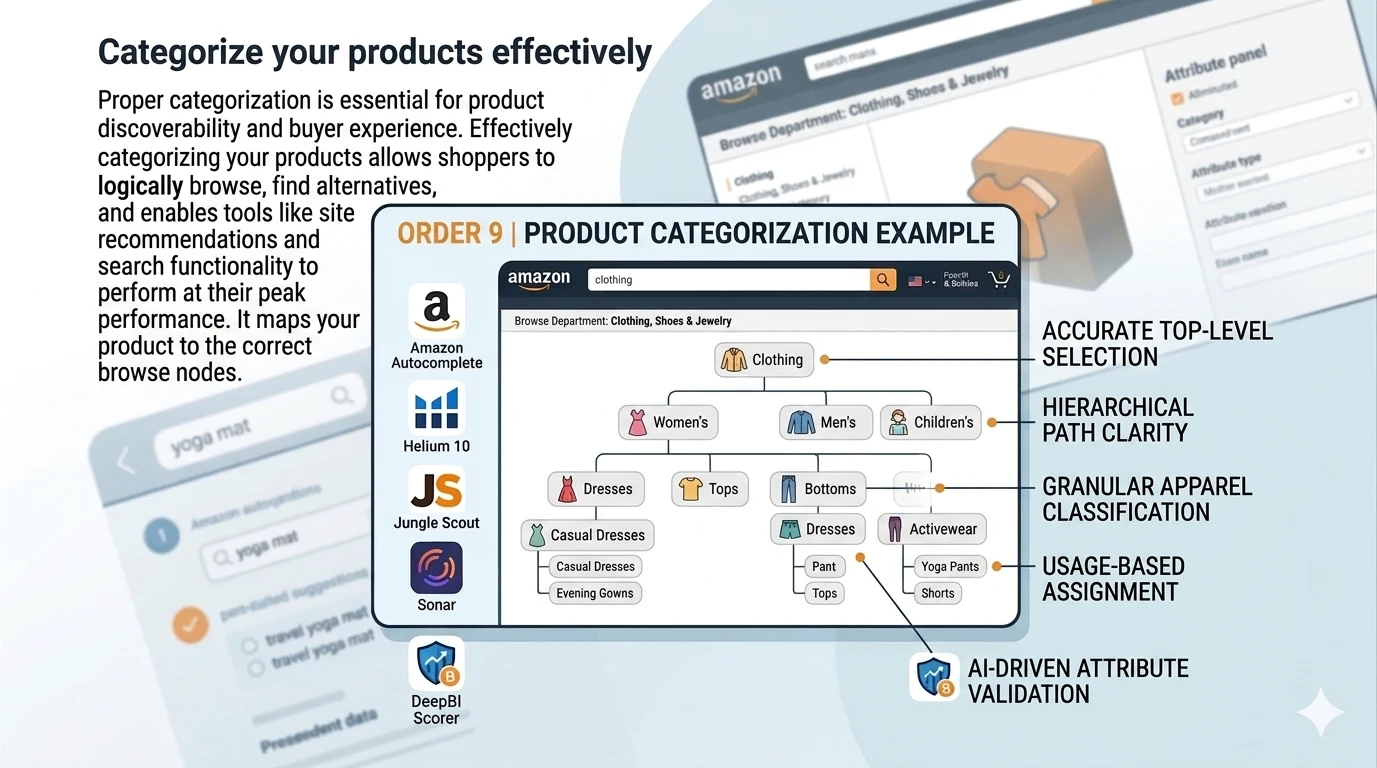
Accurate product categorization is the structural foundation of an engineered path toward marketplace visibility. On Amazon, the placement of a listing within the correct category and subcategory does more than just organize the catalog; it dictates how the A9 algorithm indexes the product and determines which customer-facing filters are unlocked. When a product is misclassified, it suffers from a fragmented traffic funnel, leading to a direct decline in CTR as it appears in irrelevant search results or fails to appear in specific browse nodes.
Selecting the most specific subcategory is essential for a quantitative audit of a listing's performance. DeepBI functions as a diagnostic radar in this process, identifying whether a listing is competing in the most profitable browse nodes or if it is hindered by "survivor bias"—the tendency to mimic the categorization of high-volume sellers who may actually be misclassified or grandfathered into older, less efficient nodes. By aligning with the most relevant category, sellers unlock specific product attributes—such as material, size, or power source—that are critical for the left-hand navigation filters used by high-intent shoppers. Failure to populate these attributes results in the listing being filtered out of the customer's view, negatively impacting CVR and increasing ACoS due to inefficient ad spend on broad, unfiltered traffic.
Furthermore, the implementation of parent-child variation listings for multiple sizes, colors, or styles is a strategic necessity for systematic optimization. Consolidating these variations under a single parent listing allows for the aggregation of customer reviews and ratings. This unified social proof significantly boosts the listing's BSR and enhances the overall CVR by providing shoppers with all available options in one location. Within the DeepBI eight-layer architecture, this data evidence chain ensures that every attribute and variation contributes to a cohesive brand presence, reducing the listing cycle time and accelerating the path to organic ranking.
Use in-platform tools to boost your listings.
The Amazon ecosystem offers a suite of native tools that serve as the foundation for any systematic optimization strategy. Enrolling in the Amazon Brand Registry is the critical first step, unlocking advanced brand protection and marketing features that directly impact long-term account health and listing authority. By integrating these internal programs, sellers can move beyond basic listing maintenance into a more aggressive growth phase.
Amazon Vine
For new product launches, the "cold start" problem often results in low CVR due to a lack of social proof. Amazon Vine provides an engineered path to overcome this by inviting trusted reviewers to share honest feedback. High-quality, early reviews generated through Vine not only improve the listing's credibility but also provide the initial data points needed for a quantitative audit of customer sentiment. This early feedback loop is essential for identifying potential product defects or messaging misalignments before scaling ad spend, ultimately accelerating the climb in BSR.
Amazon advertising options
Amazon’s advertising suite—comprising Sponsored Products, Sponsored Brands, and Sponsored Display—is essential for capturing high-intent traffic and maintaining category dominance. By strategically deploying these formats, sellers can maximize CTR through top-of-search placements and defend their brand territory from competitors. Effective management of these tools is measured by the continuous refinement of ACoS, ensuring that every dollar spent on visibility translates into profitable conversion growth and higher organic ranking.
Fulfillment by Amazon (FBA)
Logistics performance is a primary driver of the Amazon Buy Box and overall BSR. By utilizing Fulfillment by Amazon (FBA), sellers leverage Amazon’s world-class distribution network to offer fast, Prime-eligible shipping. This removal of fulfillment friction significantly boosts CVR and reduces the operational listing cycle time.
A+ Content
A+ Content allows brand owners to replace plain text descriptions with rich multimedia modules. This visual storytelling is not merely aesthetic; it is a conversion engine that reduces bounce rates and addresses customer objections before they lead to returns. By integrating multi-modal AI analysis, sellers can ensure their A+ Content aligns with the "product DNA" identified during the competitive research phase. This creates a cohesive brand experience that drives higher lifetime value and establishes a professional presence that is necessary for winning across competitive marketplaces.

Conclusion
The eight strategies discussed—ranging from competitive benchmarking to AI-driven visual production—form a cohesive framework for Amazon marketplace dominance. At the heart of this framework is DeepBI, which functions not merely as a scoring utility but as a "pre-diagnostic radar." By establishing a rigorous data evidence chain through a process of massive data capture, logical cleaning, and multimodal diagnosis, the system ensures that every listing adjustment is rooted in objective reality rather than intuition.
Success on Amazon requires a transition from fragmented updates to a systematic optimization workflow. This engineered path moves strictly from Intelligent Scoring (Diagnosis) to Optimization Suggestions (Strategy), followed by AI Image Generation (Production), and finally One-click Application (Delivery). This sequence is critical; attempting to generate visual assets without a prior quantitative audit leads to the "product-image mismatch" that often results in high ACoS and wasted ad spend.
By integrating these data-driven layers, sellers can achieve measurable improvements across the entire operational lifecycle. Precise diagnostics lead to higher CTR through better-aligned hero images, while strategy-backed infographics directly boost CVR by addressing specific customer pain points identified in the data. Ultimately, this reduces the listing cycle time and stabilizes the BSR, creating a sustainable loop of long-term growth. In an increasingly competitive landscape, the ability to transform raw marketplace data into executable AI instructions is the defining factor for scaling successfully on the global stage.
9、Amazon Listing Optimization FAQs
How does Amazon PPC impact product ranking and sales?
Amazon PPC functions as a high-velocity catalyst for organic growth. While paid traffic does not directly change organic rank, the resulting sales velocity and conversion data significantly influence the A9 algorithm. When a campaign is managed through systematic optimization, high Click-Through Rates (CTR) and Conversion Rates (CVR) signal to Amazon that the product is relevant to specific search queries. This relevance improves the Best Sellers Rank (BSR), which in turn elevates organic positioning. By maintaining a healthy balance between organic and paid sales, sellers can stabilize their ACoS while ensuring the listing remains visible in top-tier search results.
What role do product reviews play in Amazon product listing optimization?
Product reviews are the primary driver of social proof and a critical component of the conversion funnel. Beyond influencing the customer's decision to purchase, a quantitative audit of review sentiment provides actionable data for refining listing copy and images. High-rated listings typically enjoy a superior CVR, which lowers the effective ACoS by making every advertising dollar more efficient. Furthermore, the presence of specific keywords within customer reviews can enhance the listing's indexing, making it easier for the algorithm to categorize the product accurately. Addressing negative feedback through product iterations is essential to maintaining a competitive BSR in high-volume categories.
What are backend keywords, and how should I use them in my listing?
Backend keywords are hidden search terms that allow sellers to index for relevant queries without cluttering the customer-facing title or bullet points. To maximize their impact, sellers should follow an engineered path for keyword selection, utilizing automated competitor search and filtering funnels to identify high-value terms that rivals may have overlooked. These should include synonyms, common misspellings, and long-tail variations that are relevant to the product but do not fit naturally into the front-end copy. Proper utilization of the 249-byte limit in the "Search Terms" field ensures broader visibility and higher CTR across a wider range of niche search queries, directly contributing to a more robust sales velocity.